Present tense, Past tense and future time
Tense is a grammatical category that is realized in English morphologically on the verb. In accordance with this criterion, English has just two tenses: the Present and the Past, as in goes/went, respectively. English has no verbal inflection to mark a future tense. The forms shall and will are not verbal inflections but modal auxiliaries which, when reduced, are attached to pronouns, not to the verb root (I’ll wait outside). Also important are the form–meaning relationships. Shall and will belong to a set of modal auxiliaries and can express meanings other than reference to future time. Instead of a future tense, English makes use of a number of combinations such as be going to to refer to future events. Compare:
They do the shopping on Saturdays. (present tense)
They did the shopping on Saturday. (past tense)
They are going to do/will do the shopping on Saturday. (lexical auxiliary/modal)
In English, therefore, the three-term semantic distinction between past, present and future time is grammaticalized as a two-term tense distinction between Past tense and Present tense.
Besides tensed forms of verbs, adverbs of time such as now, then, tomorrow, PPs such as in 1066 and lexico-grammatical expressions such as ten minutes after the plane took off can make reference to time. English, in fact, relies to a considerable extent on such units to make the temporal reference clear.
The Past tense in English is the marked form. Morphologically, the vast majority of verbs in English have a distinctive past form, (played, saw, flew) and, semantically, the past tense basically refers to a situation that is prior to the present, as in Yesterday was fine. Cognitively, the situations conceptualized by the speaker as past have the status of known, but not immediate, reality; they are not currently observed.
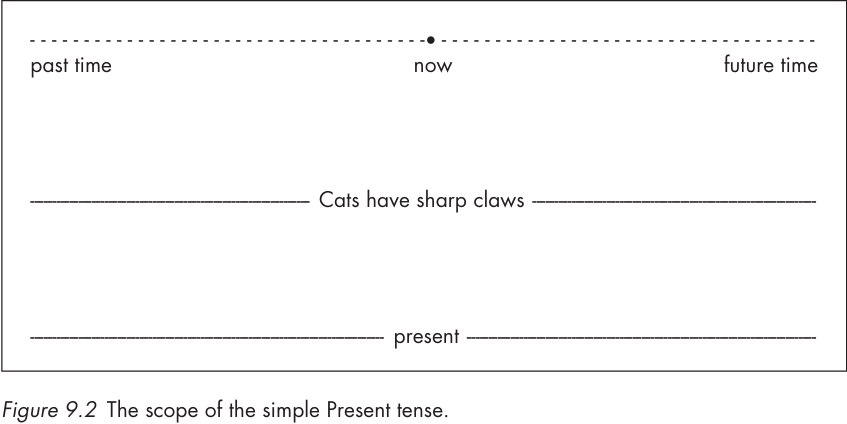
The Present tense is the unmarked tense. Morphologically, it uses mainly the base form. It is marked only on the 3rd person singular (with the exception of be, which has three forms (am, are and is). Semantically, it covers a wider range of temporal references than the Past tense, including reference to future time (Tomorrow is a holiday). Cognitively, it expresses situations which have immediate reality, that is, what is currently observed.
Even in our everyday use, ‘at present’ and ‘at the present time’ have a wider application than simply to the present moment of speech time. The present tense refers to general or permanent situations, facts and truths, which hold not only at the present time but have also held in the past, and will conceivably continue to hold in the future.