0
EN
1
المرجع الالكتروني للمعلوماتية

Grammar

Tenses

Present

Present Simple

Present Continuous

Present Perfect

Present Perfect Continuous

Past

Past Simple

Past Continuous

Past Perfect

Past Perfect Continuous

Future

Future Simple

Future Continuous

Future Perfect

Future Perfect Continuous

Parts Of Speech

Nouns

Countable and uncountable nouns

Verbal nouns

Singular and Plural nouns

Proper nouns

Nouns gender

Nouns definition

Concrete nouns

Abstract nouns

Common nouns

Collective nouns

Definition Of Nouns

Animate and Inanimate nouns

Nouns

Verbs

Stative and dynamic verbs

Finite and nonfinite verbs

To be verbs

Transitive and intransitive verbs

Auxiliary verbs

Modal verbs

Regular and irregular verbs

Action verbs

Verbs

Adverbs

Relative adverbs

Interrogative adverbs

Adverbs of time

Adverbs of place

Adverbs of reason

Adverbs of quantity

Adverbs of manner

Adverbs of frequency

Adverbs of affirmation

Adverbs

Adjectives

Quantitative adjective

Proper adjective

Possessive adjective

Numeral adjective

Interrogative adjective

Distributive adjective

Descriptive adjective

Demonstrative adjective

Pronouns

Subject pronoun

Relative pronoun

Reflexive pronoun

Reciprocal pronoun

Possessive pronoun

Personal pronoun

Interrogative pronoun

Indefinite pronoun

Emphatic pronoun

Distributive pronoun

Demonstrative pronoun

Pronouns

Pre Position

Preposition by function

Time preposition

Reason preposition

Possession preposition

Place preposition

Phrases preposition

Origin preposition

Measure preposition

Direction preposition

Contrast preposition

Agent preposition

Preposition by construction

Simple preposition

Phrase preposition

Double preposition

Compound preposition

prepositions

Conjunctions

Subordinating conjunction

Correlative conjunction

Coordinating conjunction

Conjunctive adverbs

conjunctions

Interjections

Express calling interjection

Phrases

Sentences

Clauses

Part of Speech

Grammar Rules

Passive and Active

Preference

Requests and offers

wishes

Be used to

Some and any

Could have done

Describing people

Giving advices

Possession

Comparative and superlative

Giving Reason

Making Suggestions

Apologizing

Forming questions

Since and for

Directions

Obligation

Adverbials

invitation

Articles

Imaginary condition

Zero conditional

First conditional

Second conditional

Third conditional

Reported speech

Demonstratives

Determiners

Direct and Indirect speech

Linguistics

Phonetics

Phonology

Linguistics fields

Syntax

Morphology

Semantics

pragmatics

History

Writing

Grammar

Phonetics and Phonology

Semiotics

Reading Comprehension

Elementary

Intermediate

Advanced

Teaching Methods

Teaching Strategies

Assessment

قم بتسجيل الدخول اولاً لكي يتسنى لك الاعجاب والتعليق.

COGNITIVE PROCESSES: KNOWING, THINKING AND BELIEVING

المؤلف:  Angela Downing

المصدر:  ENGLISH GRAMMAR A UNIVERSITY COURSE

الجزء والصفحة:  P173-C5

2026-05-25

40

+

-

20

COGNITIVE PROCESSES: KNOWING, THINKING AND BELIEVING

Cognitive processes are encoded by such stative verbs as believe, doubt, guess, know, recognize, think, forget, mean, remember, understand. A selection of examples is given below. Feel is also regularly used as an equivalent of ‘believe’. Most verbs of cognition have as their Phenomenon a wide range of things apprehended, including human, inanimate and abstract entities encoded as nominal groups (a) and (b). Facts, beliefs, doubts, perceptions and expectations are encoded as finite that-clauses (c) and (f), finite wh-clauses (e), or non-finite clauses.
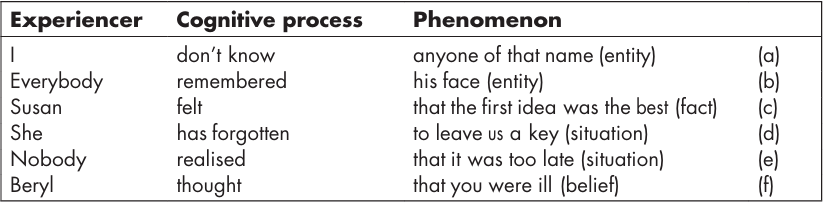


Many cognitive processes allow the Phenomenon to be unexpressed when this is ‘Given information’, for example I don’t know, Jill doesn’t understand, Nobody will remember.


In the following short extract, the author has chosen processes of cognition, perception, affection and one behavioral to reflect the mental make-up of a meteorologist whose work contributed to chaos theory:

Lorenz enjoyed 1 weather – by no means a prerequisite for a research meteorologist. He savored2 its changeability. He appreciated 3 the patterns that come and go in the atmosphere, families of eddies and cyclones, always obeying mathematical rules, yet never repeating themselves. When he looked4 at clouds he thought 5 he saw 6 a kind of structure in them. Once he had feared 7 that studying the science of weather would be like prying a jack-in-the-box apart with a screwdriver. Now he wondered 8 whether science would be able to penetrate the magic at all. Weather had a flavor that could not be expressed by talking about averages.

(James Gleick, Chaos, Making a New Science)


1affection; 2perception; 3cognition; 4behavioural; 5cognition; 6perception; 7affection; 8cognition


اخر الاخبار

اشترك بقناتنا على التلجرام ليصلك كل ما هو جديد

