Realizations of the Direct Object
The Direct Object can be realized by groups and by clauses. There are five main possibilities:
A. Nominal Group – We hired a caravan
The typical realization of the Direct Object function is the nominal group, ranging from a pronoun 1 or proper name to full NGs 2. As new entities are often introduced into the discourse in object position, the principle of end-weight can make for the frequent occurrence of longer and more complex NGs at Direct Object in certain registers as in 3:
1 I don’t understand it.
2 Have you read that new novel I lent you?
3 Forest fires are threatening the world’s remaining population of orang-utangs.
A small number of common verbs take non-typical direct objects. They include verbs such as have (They have two cars), cost (it cost ten pounds), lack (She lacks confidence), resemble (She resembles her elder sister), fit (Do these shoes fit you?), suit (That color doesn’t suit me), weigh (The suitcase weighs twenty kilos), contain (That box contains explosives) and measure (It measures two meters by three.) All these answer questions with What? Who? How much/how many?, as is usual with Ods. These verbs don’t passivize, but their Ods pass the wh-cleft test: What she lacks is confidence.
B. Anticipatory it – I find it strange that she left
The semantically empty pronoun it is necessary as an ‘anticipatory Direct Object’ in SPOdCo structures in which the Od is realized by a finite or non-finite clause:
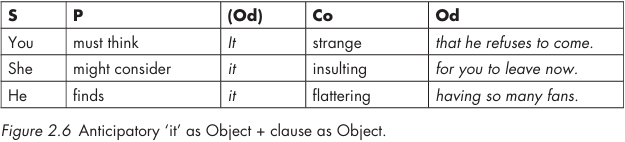
C. Finite clause – You know (that) I’m right
The two types of finite clause found at subject can also function as a less typical Direct Object: nominal that-clauses, that often being omitted in informal styles, and wh-clauses.
They fear that there may be no survivors. (nominal that-clause)
No-one knows where he lives. (wh-clause)
You can eat whatever you like. (wh-nominal clause)
Both that-clauses and wh-clauses at Od can sometimes become subject in a passive clause and then extraposed:
It is feared that there may be no survivors. (extraposed that-cl.)
It is not known where he lives.
However, passivation is not a unique criterion for assigning object status. A more reliable test is the wh-cleft paraphrase. We can apply this to the following example with wonder, which rejects passivization but fulfils the wh-cleft test:
I wonder whether they know the truth.
*Whether they know the truth is wondered.
What I wonder is whether they know the truth.
D. Non-finite clause – They enjoy travelling by train
Non-finite clauses realizing Direct Object function are of two types: infinitive clauses with or without to, and -ing clauses.
Many Londoners prefer to travel by train.
Many Londoners prefer travelling by train.
We analyze such clauses as embedded at Od on the strength of the following criteria:
The non-finite clause can be replaced by a NG (prefer the train) or by it/that (prefer it/that).
The non-finite clause can be made the focus of a wh-cleft sentence (What many Londoners prefer is to travel/travelling by train).
However, not all non-finites pass these tests. We do not analyze as embedded clauses chain-like structures (catenatives) as in He failed to appear, I tried to speak. Although superficially similar, they do not fulfil the above criteria. Taking He failed to appear, we can’t say *He failed it, nor make a corresponding cleft *What he failed was to appear. As a full lexical verb, as in fail the exam, fail does of course fulfil these criteria.
Many embedded clauses at direct object, as with subject, occur with an explicit subject of their own; otherwise, the implicit subject is the same as that of the main clause:
(a) to-infinitive clause –
The villagers want to leave immediately. (implicit subject [they])
The villagers want the soldiers/them to leave immediately. (explicit subject the soldiers)
(b) -ing clause subject – (with genitive or objective case)
Do you mind waiting a few minutes? (with implicit subject)
Do you mind my/me waiting a few minutes? (with explicit subject in objective or possessive case)
(c) to-infinitive or -ing clause –
He hates telling lies. (implicit subject)
He hates people telling lies. (explicit subject)
He hates for people to tell lies. (for + explicit subject + to-inf ) (AmE)
Again, non-finite clauses are very non-prototypical direct objects. They represent situations, not entities, and do not easily passivize. However, many can become the focus in a wh-cleft: What he hates is people telling lies/for people to tell lies.
E. Prepositional Phrase – The boss prefers before 10 for the meeting
Prepositional phrases of time or place can marginally realize direct object and subject:
Just before breakfast is not a good time.








