Attributive possession
Possessive constructions and the recursive structure associated with them can frequently be traced back to non-recursive structures. These constructions are frequently encoded by case markers, in particular genitive inflections. Most of these case markers are etymologically opaque, that is, their genesis is beyond the scope of the methodology of historical linguistics. But there are case markers and the possessive constructions associated with them for which there exists sufficient diachronic evidence to allow for generalizations on their genesis. The diachronic sources of these constructions are discussed in Heine (1997a; see also Heine and Kuteva 2002a: 34–5) and the reader is referred to these works for more details. The main conceptual schemas serving as sources for the rise of attributive possession are listed in Table 6.2.
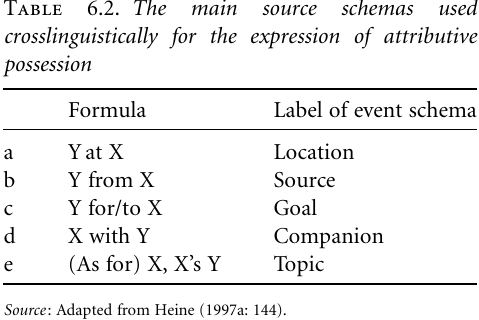
Three of the schemas listed there (location, source, and goal) can be described in a broad sense as being spatial in nature, whereby the possessor is conceptualized as a spatially described participant. In European languages, the schema predominantly recruited is the source schema, where the possessor is presented by means of an ablative preposition (‘(away) from’, ‘out of’), for example English of, German von, Dutch van, Frisian fan, Catalan de, Macedonian od, Upper Sorbian wot, etc. Thus, there was a historical development whereby a locative prepositional construction of the form [‘from’ NP] developed into a possessive/genitive construction [GEN possessor]. For example, the Latin prepositional construction [dē X ‘from X’] is the historical source of attributive possessive constructions to be found in the modern Romance languages, as well as of the productive recursive structure exhibited by these constructions, for example French le chien de l’ami de mon père, in much the same way as the corresponding recursion in the English translation ‘the dog of the friend of my father’ is the result of a process from prepositional phrase to genitive/possessive construction.
This process can be illustrated with an English example. In Old English, of was a low stress variant of an Old English adverb and preposition meaning ‘away’, ‘away from’, as in (10a).In Late Old English and Early Middle English, of came to acquire uses occurring between two noun phrases, where its meaning gradually shifted from the older ‘springing or coming from, belonging by origin to’ to ‘belonging to a place, as a native or resident’, and in the eleventh century to ‘belonging to as inhabitants or occupants’, ‘living in’, and ‘things situated in or at’; an example is provided in (10b).
(10) a. Old English (Anglo-Saxon Chronicle (Parker), 658 AD; OED)
Þis wœs gefohten siþþan he of Eastenglum com.
b. Early Middle English (ca. 1160, Anglo-Saxon Chronicle (Laud), 1132 AD; OED)
Was it noht suithe lang þer efter þatte king ... dide him gyuen up ðet abbotrice of Burch.
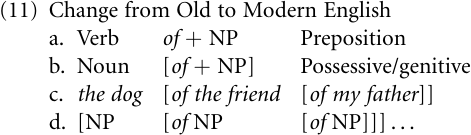
The change from Early Middle English to Modern English was marked by extension and desemanticization: of was extended to more and more contexts, spreading from one noun to another, increasingly encroaching on the domain reserved for the inflectional genitive. And from Middle English onwards it became the primary means for expressing attributive possession—turning into a fully productive marker of linking nouns. In other words, what used to be an adverb and preposition turned into a new case marker of noun phrase syntax in a process leading from a structure like (11a) to one like (11b). The result is that English acquired a new pattern of recursive syntax, illustrated in (11c), whose structure can be described as in (11d).
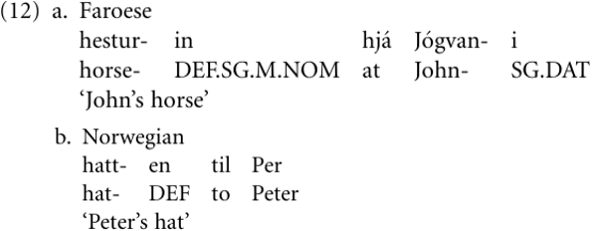
Much the same process happened in other European languages. In a number of northern European languages it was not the source schema of Table 6.2 but the location schema that was used to create new possessive constructions along the same lines, where a locative preposition ‘at’ was grammaticalized to a possessive/genitive case marker, such as Faroese hja̒ ‘at’, Scottish Gaelic aig ‘at’, or Irish ag ‘at’; cf. (12a). In the case of the goal schema, attributive possession can be traced back to a directional, allative or benefactive adverbial phrase, where the adposition turned into a possessive case marker, as appears to have happened with Norwegian til ‘to’, illustrated in (12b).
To conclude, one way in which recursion in possessive constructions arises is via the reinterpretation and subsequent grammaticalization of locative or comitative adverbial phrases as possessive/genitival modifiers (Heine 1997a). Grammaticalization has the effect that the erstwhile preposition undergoes desemanticization: It loses its spatial meaning (of location, source, goal, etc.) and turns into a marker whose function is restricted essentially to marking a case relation. Decategorialization can be seen in the fact that the erstwhile preposition loses its ability to introduce participants of the clause, becoming restricted to one kind of context, namely that of linking a modifier to its head constituents within the noun phrase. And frequently there is also erosion, in that the preposition tends to lose its ability to receive stress or may be phonetically reduced on the way to becoming a case marker.








