Assessment as the driver for learning in ITN338
In terms of content, the unit ITN338 was predominantly issues-focused. There was a particular theme each week, with a guest speaker with in-depth knowledge of the theme to introduce students to the critical issues that impacted directly on their own work in the library and information sector. The idea of an online journal made it possible to develop the issues further: in writing their journal article, students would be given a chance to explore one specific issue of interest in depth, while the oral presentation offered an opportunity for students to share their learning about the broad range of issues they were addressing individually. The collaborative dimension could be achieved through editorial teams producing the weekly issues of the journal. There was also scope to introduce the peer review process to encourage students to focus on the quality of professional writing and the value of scholarly publishing. Accordingly, the process of learning and the product of learning were viewed cohesively.
At the beginning of the semester, the students spent time reviewing the Study Guide which provided information on the individual assignment tasks and how they were integrated in the unit. There was a classroom discussion on criterion referenced assessment in general and within the unit in particular. Importantly, any assessable aspect of learning was incorporated into the classroom learning activities themselves. Early in the semester, the students participated in an interactive workshop designed to support them as they explored new territory. The workshop topics included:
• What was involved in creating an online journal
• How to be part of a productive self-managed editorial team
• The process of scholarly publishing and peer review activities
In the first part of the semester, students worked independently on their journal article and collaboratively with their editorial team to plan their issue of the online journal. They submitted a draft outline of the article they proposed to write and received formative feedback on this, which also gave the teaching staff an idea about the scope of each weekly issue of the online journal. Throughout the semester, each editorial group published their issue of the journal on the OLT site. In the second half of the semester, students were asked to give an oral presentation on their chosen topic, based on the article they had written for the online journal. All students were expected to read and consider the issues presented in the relevant articles each week so that they came to the seminars informed and prepared to contribute to the discussion. The different learning activities were reflected in the four pieces of assessment (Table 1):
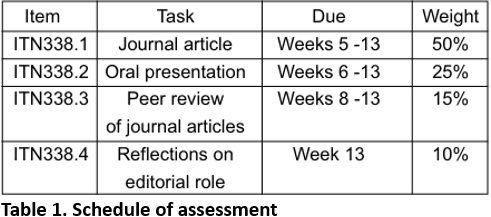
The academic staff hoped that the assessment activities would not only drive student learning, but would also encourage students to take responsibility for managing their own individual and collaborative learning activities to achieve the desired learning outcomes. The online journal was therefore central to learning and assessment in this unit, as illustrated in the diagram below:
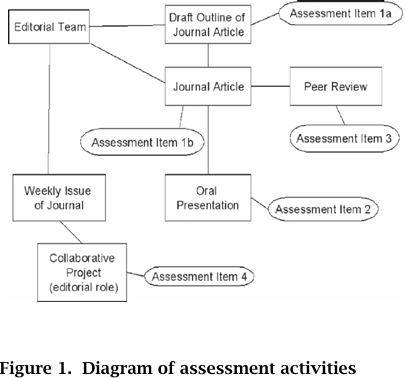
The journal article itself (ITN338.1) was weighted at 50% of the total assessment, as it was regarded as the key independent learning activity with the emphasis placed on researching a topic of current interest. Some sample topics were provided, but students were encouraged to select an issue that they personally wished to examine. It should be noted that the actual research skills that underpin the development of the journal article represent a critical dimension of the successful library and information professional. As effective planning for the discrete issues of the online journal would contribute significantly to its success, the draft outline had a 5% weighting of its own, to ensure students do submit this promptly.
To help students engage with both the learning activities and the CRA assessment process, it was decided that the assessment criteria for one assignment, the peer review process, would be developed collaboratively by the students and academic staff as part of the workshop program. Claxton (1995) supports the idea of student involvement in negotiating or determining the criteria for an assessment task, as "here students are experiencing a greater degree of trust and responsibility, and can be helped to experience and to understand for themselves what some of the difficulties are for designing forms of evaluation that are valid and fair" (p.342). Involvement in the development of assessment criteria enables students to learn about the assessment culture of higher education (Race, 2001), which in turn may be applied in the increasing role of library and information professionals in the delivery of formal and informal learning programs.
The personal philosophies of learning and teaching that underpin the approaches to assessment in ITN338 recognize that appropriate assessment design is crucial for effective learning. The goal to achieve an integrated set of assessment tasks finds resonance with Bowden and Marton (1998) who believe that "an integrative approach to assessment" (p.162) plays an important role in driving the teaching and learning process.
The creation of the right assessment culture is an important element in ITN338, reflecting the views of Zessoules and Gardner (1991) to strive to nurture complex understanding, to develop reflective habits of mind, to document students' evolving understandings and to make use of assessment as a moment of learning. Such an assessment culture "has the potential to accommodate fuller, more dynamic evaluations of student understanding, because it has the power to integrate assessment with learning and instruction" (p. 61). As postgraduate students, the GDLIS students generally establish their own clearly defined goals for learning and respect a number of core attributes in their assessment tasks:
• Unambiguous expectations
• Authentic tasks
• Choice and flexibility
The interest in 'negotiated assessment tasks' is viewed by Centre for the Study for Higher Education (CSHE, 2002) as "a natural extension of the trend towards offering students more flexible ways of studying and more choice in study options" (p.10). The assessment strategies in place in ITN338 certainly aim to support students to study more effectively by helping them arrange their timetables for submitting assessable work to suit their overall workload. This approach, plus the encouragement to engage with the curriculum itself, "should assist them to become more autonomous and independent learners" (p.10).
With the strong emphasis placed on assessment activities which focus on student learning, it is important to acknowledge the students' own different motivations for learning and the individuality of desired learning outcomes. Sullivan and Hall (1997) highlight the student-orientation of a number of significant approaches to teaching and learning, such experiential learning (Kolb, 1984), open learning (Rowntree, 1992), problem-based learning (Boud, 1985), action learning and action research (Zuber-Skerrit, 1990), and personal reflection (Schön,1987). Sullivan and Hall (1997) stress that these approaches are valuable in motivating student learning, and self-reflection on learning, by providing the opportunity to stimulate interest, thinking and involvement. While the subject matter is not ignored, student learning needs become the principal focus so that students can apply their learning in different situations.
The QUT Assessment Policy (2003) highlights the value of self- and peer-assessment to support students in the process of making evaluative judgements about their own work and to encourage students to consider their own achievements in their academic work. Race (2001) notes that self-assessment can be especially valuable when reflective practice supports the personal understanding of learning goals and learning outcomes. It is argued that students spontaneously undertake self and peer- assessment, so that academic input into the process supports a deeper learning experience, together with the development of skills which will be of ongoing value for performance appraisal in the workplace. A further dimension of self-assessment in ITN338 is encouragement of the graduate's engagement in lifelong learning activities. The ability to identify one's own need for continuing learning as part of career-long development will support personal and professional growth and, given the dynamic nature of library and information work, is especially important for information professionals in the 21st century.








