0
EN
1
المرجع الالكتروني للمعلوماتية

Grammar

Tenses

Present

Present Simple

Present Continuous

Present Perfect

Present Perfect Continuous

Past

Past Simple

Past Continuous

Past Perfect

Past Perfect Continuous

Future

Future Simple

Future Continuous

Future Perfect

Future Perfect Continuous

Parts Of Speech

Nouns

Countable and uncountable nouns

Verbal nouns

Singular and Plural nouns

Proper nouns

Nouns gender

Nouns definition

Concrete nouns

Abstract nouns

Common nouns

Collective nouns

Definition Of Nouns

Animate and Inanimate nouns

Nouns

Verbs

Stative and dynamic verbs

Finite and nonfinite verbs

To be verbs

Transitive and intransitive verbs

Auxiliary verbs

Modal verbs

Regular and irregular verbs

Action verbs

Verbs

Adverbs

Relative adverbs

Interrogative adverbs

Adverbs of time

Adverbs of place

Adverbs of reason

Adverbs of quantity

Adverbs of manner

Adverbs of frequency

Adverbs of affirmation

Adverbs

Adjectives

Quantitative adjective

Proper adjective

Possessive adjective

Numeral adjective

Interrogative adjective

Distributive adjective

Descriptive adjective

Demonstrative adjective

Pronouns

Subject pronoun

Relative pronoun

Reflexive pronoun

Reciprocal pronoun

Possessive pronoun

Personal pronoun

Interrogative pronoun

Indefinite pronoun

Emphatic pronoun

Distributive pronoun

Demonstrative pronoun

Pronouns

Pre Position

Preposition by function

Time preposition

Reason preposition

Possession preposition

Place preposition

Phrases preposition

Origin preposition

Measure preposition

Direction preposition

Contrast preposition

Agent preposition

Preposition by construction

Simple preposition

Phrase preposition

Double preposition

Compound preposition

prepositions

Conjunctions

Subordinating conjunction

Correlative conjunction

Coordinating conjunction

Conjunctive adverbs

conjunctions

Interjections

Express calling interjection

Phrases

Sentences

Clauses

Part of Speech

Grammar Rules

Passive and Active

Preference

Requests and offers

wishes

Be used to

Some and any

Could have done

Describing people

Giving advices

Possession

Comparative and superlative

Giving Reason

Making Suggestions

Apologizing

Forming questions

Since and for

Directions

Obligation

Adverbials

invitation

Articles

Imaginary condition

Zero conditional

First conditional

Second conditional

Third conditional

Reported speech

Demonstratives

Determiners

Direct and Indirect speech

Linguistics

Phonetics

Phonology

Linguistics fields

Syntax

Morphology

Semantics

pragmatics

History

Writing

Grammar

Phonetics and Phonology

Semiotics

Reading Comprehension

Elementary

Intermediate

Advanced

Teaching Methods

Teaching Strategies

Assessment

قم بتسجيل الدخول اولاً لكي يتسنى لك الاعجاب والتعليق.

Development of Revised Tool

المؤلف:  Sherria Hoskins & Carolyne Jacobs & Heather MacKenzie

المصدر:  Enhancing Teaching and Learning through Assessment

الجزء والصفحة:  P191-C17

2025-07-03

699

+

-

20

Development of Revised Tool

The factor analysis indicated that the structure of the questionnaire could be improved. Therefore the exercise was repeated in order to identify the most convincing factor structure. In the first stage, item analysis, items were removed if they failed to discriminate between individual students, this included items where more than 65% of participants responded at one end of the scale (e.g. they all agreed with the item being presented). Items 2g, 6b and 6j were removed.


The amended data was subjected to Principal Components Factor Analysis, on this occasion without a pre-determined number of factors. A scree plot indicated the optimum factor structure and again a 6 factor solution emerged. The emergent factors were as follows:

Factor 1: Numeracy, mapping to the Numeracy section of the original ILP questionnaire.

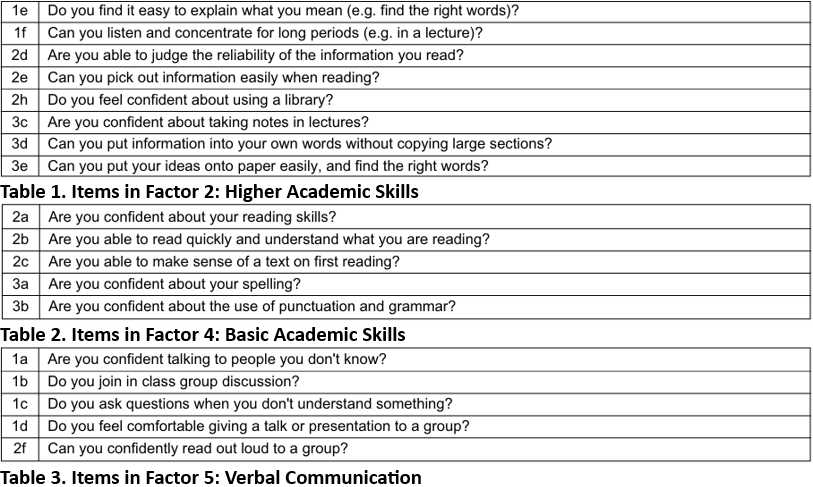
Factor 2: Higher Level Academic Skills. Factor 2 was less clear to interpret as items included those from Section 1: Speaking and Listening, Section 2: Reading and Researching, and Section 3: Writing of the existing ILP. The research group felt that these items could usefully be grouped under the heading Higher Academic Skills -see Table 1.

Factor 3: Information Technology. This factor maps directly to the IT section of the original ILP questionnaire.

Factor 4: Basic Academic Skills. Factor 4 again combines items from the Reading and Researching and Writing sections of the original ILP. The team entitled this section Basic Academic Skills (see Table 2).

Factor 5: Verbal Communication. Factor 5 comprised the majority of items from Section 1: Speaking and Listening of the existing ILP and one item from Section 2: Reading and Researching (see Table 3). This factor clearly identifies confidence in verbal communication skills.

Factor 6: Time Management. The time management section of the existing ILP was fully replicated in factor 6.


All factors show excellent internal consistency and split-half reliability (above 6 factors in all cases).


Clearly then, the psychometric analysis indicates that the structure of the original ILP is robust with strong internal reliability and consistency. The grouping of questions is borne out in the statistical analysis. However, this analysis also revealed where improvements could be made to the factor structure of the ILP (in other words the way in which questions are grouped and thus scored) by re-grouping a number of items in 6 new sections: Verbal Communication, Basic Academic Skills, Higher Academic Skills, Time Management, Numeracy and IT. The research team considered that the reference to academic learning in the new structure be more persuasive when convincing academic staff and students about the value of engaging in PDP activities.
لا توجد تعليقات بعد

ما رأيك بالمقال : كن أول من يعلق على هذا المحتوى

اخر الاخبار

اشترك بقناتنا على التلجرام ليصلك كل ما هو جديد


