Grammar
Tenses
Present

Present Simple
Present Continuous
Present Perfect
Present Perfect Continuous
Past
Past Simple
Past Continuous
Past Perfect
Past Perfect Continuous
Future
Future Simple
Future Continuous
Future Perfect
Future Perfect Continuous
Parts Of Speech
Nouns
Countable and uncountable nouns
Verbal nouns
Singular and Plural nouns
Proper nouns
Nouns gender
Nouns definition
Concrete nouns
Abstract nouns
Common nouns
Collective nouns
Definition Of Nouns
Animate and Inanimate nouns
Nouns
Verbs
Stative and dynamic verbs
Finite and nonfinite verbs
To be verbs
Transitive and intransitive verbs
Auxiliary verbs
Modal verbs
Regular and irregular verbs
Action verbs
Verbs
Adverbs
Relative adverbs
Interrogative adverbs
Adverbs of time
Adverbs of place
Adverbs of reason
Adverbs of quantity
Adverbs of manner
Adverbs of frequency
Adverbs of affirmation
Adverbs
Adjectives
Quantitative adjective
Proper adjective
Possessive adjective
Numeral adjective
Interrogative adjective
Distributive adjective
Descriptive adjective
Demonstrative adjective
Pronouns
Subject pronoun
Relative pronoun
Reflexive pronoun
Reciprocal pronoun
Possessive pronoun
Personal pronoun
Interrogative pronoun
Indefinite pronoun
Emphatic pronoun
Distributive pronoun
Demonstrative pronoun
Pronouns
Pre Position
Preposition by function
Time preposition
Reason preposition
Possession preposition
Place preposition
Phrases preposition
Origin preposition
Measure preposition
Direction preposition
Contrast preposition
Agent preposition
Preposition by construction
Simple preposition
Phrase preposition
Double preposition
Compound preposition
prepositions
Conjunctions
Subordinating conjunction
Correlative conjunction
Coordinating conjunction
Conjunctive adverbs
conjunctions
Interjections
Express calling interjection
Phrases
Sentences
Clauses
Part of Speech
Grammar Rules
Passive and Active
Preference
Requests and offers
wishes
Be used to
Some and any
Could have done
Describing people
Giving advices
Possession
Comparative and superlative
Giving Reason
Making Suggestions
Apologizing
Forming questions
Since and for
Directions
Obligation
Adverbials
invitation
Articles
Imaginary condition
Zero conditional
First conditional
Second conditional
Third conditional
Reported speech
Demonstratives
Determiners
Direct and Indirect speech
Linguistics
Phonetics
Phonology
Linguistics fields
Syntax
Morphology
Semantics
pragmatics
History
Writing
Grammar
Phonetics and Phonology
Semiotics
Reading Comprehension
Elementary
Intermediate
Advanced
Teaching Methods
Teaching Strategies
Assessment


Verb and verb phrase Forms of the verb
 المؤلف:
R.M.W. Dixon
المؤلف:
R.M.W. Dixon
 المصدر:
A Semantic approach to English grammar
المصدر:
A Semantic approach to English grammar
 الجزء والصفحة:
22-2
الجزء والصفحة:
22-2
 2023-03-08
 1955
1955




+
-
20
Verb and verb phrase
We first examine the forms of the verb, and the elements which can make up a verb phrase, before setting out the systems of mood, reality status, modality, tense and aspect which underlie the English predicate, and the way in which the terms in these systems are marked.
Forms of the verb
It is important to distinguish between the base form of a verb, the three tense forms, and the two non-tense suffixed forms. Illustrating for one regular and three sample irregular verbs:
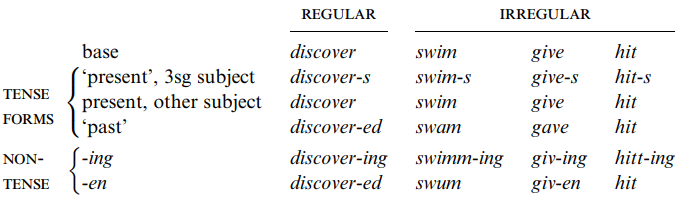
Be (base form) is the most irregular verb, with am for 1sg subject, is for 3sg m, f and n and are elsewhere in present; was for 1sg and 3sg m, f and n and were elsewhere in the past; plus being and been. All other verbs are regular for present and the -ing form; irregularities are found for irregular verbs in past tense and in the -en form.
The tense forms are used in main clauses and must be preceded by a subject (at the least, the impersonal subject, it); the only circumstance in which a subject can be omitted is when two clauses with identical subject are coordinated, e.g. John came in and sat down. The base form is used in the imperative, and after to (the misnamed ‘infinitive’).
Non-tense forms are used after auxiliary verbs: -ing after ‘imperfective’ be; -en after ‘previous’ have and after passive be (e.g. was giving; had given, was given). In addition, -ing is used in varieties of complement clause, one often with’s on the subject (if it is stated), e.g. I like Mary(’s) playing the piano; the other with from between subject and verb, e.g. I discouraged John from going. It can also mark the predicate of a circumstantial clause, e.g. Having made his will, he shot himself, and Being absorbed in her task, she didn’t notice the tiger approach. Both -ing and -en forms may also function as adjectival modifiers within an NP, although only some verbs have (one or both of) their non-tense forms used in this way, e.g. worrying news, worried expression, helping hand, informed reply, swum distance.
Unlike tense forms, the non-tense forms do not have to be preceded by a stated subject within that clause, e.g. I like playing the piano, and the two circumstantial clauses given in the last paragraph.
(nouns can be derived from some verbs and this sometimes involves the addition of -ing, e.g. the singing of the birds, the rocking of the boat. But with many verbs a different derivational form is used, e.g. the departure of the army, rather than *departing, and decision not *deciding, belief not *believing, etc. Or the same form can be used for verb base and noun, e.g. laugh, bite, witness.)
It is informative to compare the past tense form, which must have a preceding subject, with the -en form, which may lack a stated subject. Compare:
(1) All students [(who were) seen in the bar last night] should report to the principal’s office at noon
(2) All teachers [who saw students in the bar last night] should report to the principal’s office at noon
The relative clause in (1) can be shortened by the omission of who (a relative pronoun filling subject slot) and were; the non-tense form seen then becomes clause-initial. Who cannot be omitted from (2); this is because the past tense form saw must be preceded by a subject.
For all regular (and some irregular) verbs the -en and past tense forms fall together—both seen in (1) and saw in (2) could be replaced by discovered. For these verbs it is important to enquire whether a form like discovered is, in a particular clause, realizing the past tense category (since it will then require a subject) or the -en category (when it will have different syntactic possibilities); if discovered is substituted for seen in (1) and for saw in (2), then we can still omit who were from (1) but not who from (2). This is parallel to the situation concerning those few nouns that have a single form for both singular and plural—there is still an operative category of number, which is realized in the form of accompanying demonstrative and verb; compare this sheep is bleating with these sheep are bleating (this versus these and is versus are showing that sheep once realizes singular and once plural number).
All verbs (except be) have a present non-3sg form that is identical to the base form. Once again, we must know what category a plain verb form is representing in a given clause. Compare I know all about your children; they eat ice cream and I said to your children: ‘(you) eat this ice cream!’ The pronoun they cannot be omitted from the first sentence since the tensed verb eat must be preceded by a subject; but the subject pronoun you can be omitted from the second sentence since the base form eat (here, in imperative function) does not require a preceding subject.
 0
0
 0
0
 الاكثر قراءة في Semantics
 اخر الاخبار
اخبار العتبة العباسية المقدسة

الآخبار الصحية


مواضيع ذات صلة
 قسم الشؤون الفكرية يصدر كتاباً يوثق تاريخ السدانة في العتبة العباسية المقدسة
 "المهمة".. إصدار قصصي يوثّق القصص الفائزة في مسابقة فتوى الدفاع المقدسة للقصة القصيرة
 (نوافذ).. إصدار أدبي يوثق القصص الفائزة في مسابقة الإمام العسكري (عليه السلام)