

Grammar


Tenses


Present

Present Simple

Present Continuous

Present Perfect

Present Perfect Continuous


Past

Past Simple

Past Continuous

Past Perfect

Past Perfect Continuous


Future

Future Simple

Future Continuous

Future Perfect

Future Perfect Continuous


Parts Of Speech


Nouns

Countable and uncountable nouns

Verbal nouns

Singular and Plural nouns

Proper nouns

Nouns gender

Nouns definition

Concrete nouns

Abstract nouns

Common nouns

Collective nouns

Definition Of Nouns

Animate and Inanimate nouns

Nouns


Verbs

Stative and dynamic verbs

Finite and nonfinite verbs

To be verbs

Transitive and intransitive verbs

Auxiliary verbs

Modal verbs

Regular and irregular verbs

Action verbs

Verbs


Adverbs

Relative adverbs

Interrogative adverbs

Adverbs of time

Adverbs of place

Adverbs of reason

Adverbs of quantity

Adverbs of manner

Adverbs of frequency

Adverbs of affirmation

Adverbs


Adjectives

Quantitative adjective

Proper adjective

Possessive adjective

Numeral adjective

Interrogative adjective

Distributive adjective

Descriptive adjective

Demonstrative adjective


Pronouns

Subject pronoun

Relative pronoun

Reflexive pronoun

Reciprocal pronoun

Possessive pronoun

Personal pronoun

Interrogative pronoun

Indefinite pronoun

Emphatic pronoun

Distributive pronoun

Demonstrative pronoun

Pronouns


Pre Position


Preposition by function

Time preposition

Reason preposition

Possession preposition

Place preposition

Phrases preposition

Origin preposition

Measure preposition

Direction preposition

Contrast preposition

Agent preposition


Preposition by construction

Simple preposition

Phrase preposition

Double preposition

Compound preposition

prepositions


Conjunctions

Subordinating conjunction

Correlative conjunction

Coordinating conjunction

Conjunctive adverbs

conjunctions


Interjections

Express calling interjection

Phrases

Sentences

Clauses

Part of Speech


Grammar Rules

Passive and Active

Preference

Requests and offers

wishes

Be used to

Some and any

Could have done

Describing people

Giving advices

Possession

Comparative and superlative

Giving Reason

Making Suggestions

Apologizing

Forming questions

Since and for

Directions

Obligation

Adverbials

invitation

Articles

Imaginary condition

Zero conditional

First conditional

Second conditional

Third conditional

Reported speech

Demonstratives

Determiners

Direct and Indirect speech


Linguistics

Phonetics

Phonology

Linguistics fields

Syntax

Morphology

Semantics

pragmatics

History

Writing

Grammar

Phonetics and Phonology

Semiotics


Reading Comprehension

Elementary

Intermediate

Advanced


Teaching Methods

Teaching Strategies

Assessment
Indefinite Pronoun
المؤلف:
COLLINS.COM
المصدر:
...
الجزء والصفحة:
...
21-5-2021
1093
Indefinite pronouns - Easy Learning Grammar
The indefinite pronouns are used when you do not know or do not need to say precisely who or what you are referring to. The noun phrase which they substitute for can refer to a person, a thing, or a group of people or things, in which gender and number are not made clear.
Someone will have to tell her that she’s failed.
Everybody had a wonderful time.
Anything is better than nothing.
Nothing can make up for this loss.
Some people like that sort of thing. Others don’t.
The indefinite pronouns can be grouped according to meaning, as follows:
A-General amounts and quantities: most, some, none, any, all, both, half, several, enough, many, each.
Many find it impossible to cope.
Congratulations from all at the club.
Judging by the comments, most wanted her to stay on.
Although we lost a lot of stuff in the fire, some was saved.
Enough has been said on this topic to fill a book.
B-Choice or alternatives: either, neither.
Could you bring me one of those spanners? Either will do.
Neither was keen on a traditional wedding.
C-Undefined singular or multiple persons and things:
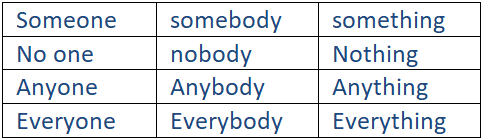
The pronouns in group C that refer to people can cause problems concerning the number and gender of a following determiner or pronoun. Traditionally, only the use of a following singular form was permitted. Common practice uses the plural form their and avoids awkward expressions like his or her.Note the form of no one or, less usually, no-one.
Everybody has their ups and downs.
Has anybody finished their lunch yet?
No one in their right mind goes on holiday there in January.
Many of these pronouns, especially those in groups A and B, have the same form as determiners. See Determiners.
The way to tell them apart is to see if the word on its own is used as a subject, an object, or the complement of a verb; if it is, it is a pronoun. If, on the other hand, it is used in front of a noun, it is a determiner.
As a pronoun:
Both were given life sentences.
Several managed to escape.
I’ve found some!
As a determiner:
Both men were given life sentences.
Several sheep managed to escape.
I’ve found some scrap paper.
The pronouns in Groups A and B are often used like partitives, with of and a noun phrase or a personal pronoun.
None of the children were hurt, but most of them were rather upset.
Neither of his parents remarried
الاكثر قراءة في Indefinite pronoun
اخر الاخبار
اخبار العتبة العباسية المقدسة
الآخبار الصحية

قسم الشؤون الفكرية يصدر كتاباً يوثق تاريخ السدانة في العتبة العباسية المقدسة
"المهمة".. إصدار قصصي يوثّق القصص الفائزة في مسابقة فتوى الدفاع المقدسة للقصة القصيرة
(نوافذ).. إصدار أدبي يوثق القصص الفائزة في مسابقة الإمام العسكري (عليه السلام)


