Non-finite Verbs
In each example, the non-finite verb is shaded and the finite verb (the main verb) is in bold. Note that you can tell whether the sentence is in the past tense, present tense, or future tense only by looking at the finite verbs (bold text). You cannot determine the tense by looking at the non-finite verbs (highlighted text).
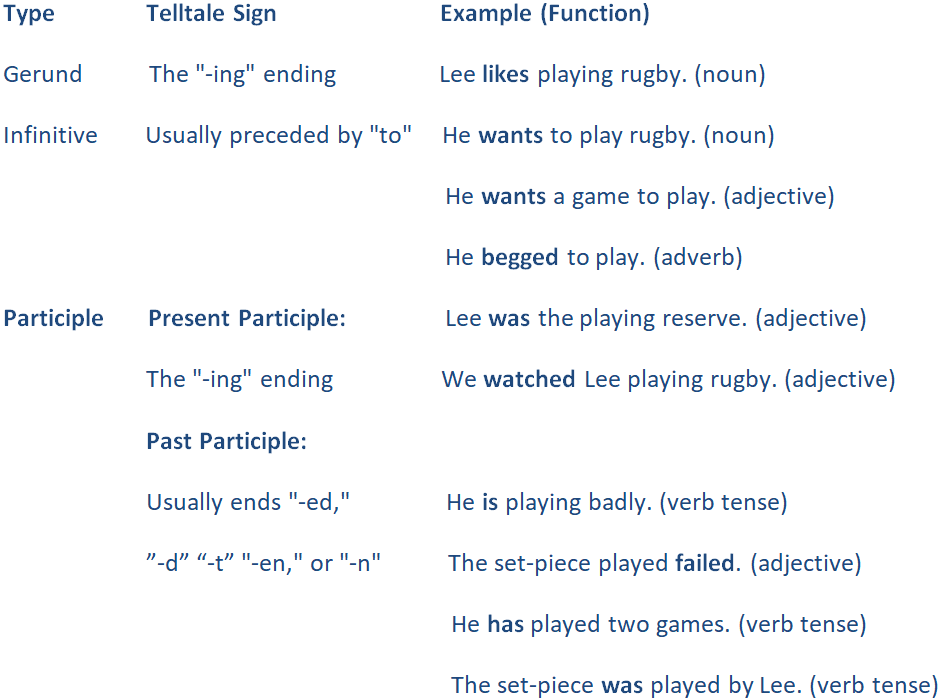
More Examples of Non-finite Verbs (Gerunds)
A gerund is a noun formed from a verb. All gerunds end "-ing."
I have never taken any exercise except sleeping and resting. (Writer Mark Twain)
Gerunds maintain some verb-like properties (e.g., they can take objects and be modified by adverbs). Therefore, a gerund will often appear in a gerund phrase, which consists of the gerund and any objects and modifiers. (In these examples, the gerund phrases are underlined, the gerunds are highlighted, and the main verb (the finite verb) is in bold.)
Art is making something out of nothing and selling it. (Musician Frank Zappa)
I started by photographing birds in my garden.
More Examples of Non-finite Verbs (Infinitives)
An infinitive is a verb form (often preceded by "to") that can function as a noun, an adjective, or an adverb.
To win was everything.
(Here, the infinitive is functioning as a noun. Compare this with "The victory was everything.")
It is the competition to win.
(Here, the infinitive is functioning as an adjective. Compare this with "It is the top competition.")
The man paid to win.
(Here, the infinitive is functioning as an adverb. It is modifying the verb "paid." Compare this with "The man paid so he could win." The clause "so he could win" is an adverbial clause of reason.)
An infinitive often appears in an infinitive phrase. An infinitive phrase consists of the infinitive and any objects and modifiers. (In these examples, the infinitive phrases are underlined, the infinitives are shaded, and the finite verbs (the main verbs) are in bold.)
She needed to find a lot of money quickly.
(The infinitive phrase is being used as a noun.)
I showed her the best way to make a Yorkshire pudding.
(The infinitive phrase is being used as an adjective.)
He set the camera to film whatever was eating his chickens.
(The infinitive phrase is being used as an adverb.)
Not all infinitives are preceded by "to." Infinitives also feature in verb chains after verbs like "could," "may," "should," and "would" (i.e., auxiliary verbs) and verbs like "to make" and "to let."
If the highest aim of a captain were to preserve his ship, he would keep it in port forever. (Saint Thomas Aquinas)
Let them eat cake. (Queen of France Marie Antoinette)
Read more about infinitives.
More Examples of Non-finite Verbs (Participles)
A participle is a verb form that can function as an adjective. There are two types of participles: the present participle (ending "-ing") and the past participle (usually ending "-ed," "-d," "-t," "-en," or "-n").
Here are some participles being used as adjectives:
The Verb The Present Participle The Past Participle
To bake the baking bread the baked bread
To print the printing document the printed document
To lower the lowering prices the lowered prices
Here are some real-life examples:
A stirring dwarf we do allowance give before a sleeping giant. (Playwright William Shakespeare)
(Here, there are two present participles functioning as adjectives.)
Food is an important part of a balanced diet. (Author Fran Lebowitz)
(Here, the past participle is functioning as an adjective.)
Often, a participle heads up a participle phrase functioning as an adjective. (In the examples, the participle phrases are underlined, the participles are shaded, and the finite verbs (the main verbs) are in bold.)
Drawing on my fine command of the English language, I said nothing. (Writer Robert Benchley)
Connected" entirely by canals and footbridges, the Dutch village of Giethoorn has no roads.
Participles are also used to form verb tenses.
I was eating beans by candle light for a decade. (Actor Eric Andre)
(Here, a present participle helps to form the past progressive tense. Note that "eating" does not give away whether the verb is past, present, or future. Only "was" (the finite verb) does. "Was" tells us this is the past tense.)
I have taken more out of alcohol than alcohol has taken out of me. (Prime Minister Winston Churchill)
(Here, a past participle helps to form two examples of the present perfect tense. Note that "taken" does not give away whether the verb is past, present, or future. Only "have" and "has" (the finite verbs) do.)
Read more about participles and tenses.
More about Non-finite Verbs
It can get complicated.
People want to win. Most people have the will to win, but few have the will to prepare to win. (Basketball coach Bobby Knight)
(Here, the first "to win" functions as a noun. The second "to win" functions as an adjective, and the third "to win" functions as an adverb that modifies "to prepare," which functions as an adjective.)
The way to make money is to buy when blood is running in the streets. (Business magnate John Davison Rockefeller)
(Here, "to make" functions as an adjective, "to buy" functions as a noun, and "running" forms the present progressive tense.)
Finite and Non-Finite Verbs Can Look Identical
Do not forget that a finite verb and a non-finite verb might look identical. Look at "roasted" in this example:
They roasted chestnuts because roasted chestnuts were profitable.
(The first "roasted" is finite. It tells us this sentence is in the past tense. The second "roasted" is non-finite. It is functioning as an adjective.)
Why Should I Care about Non-finite Verbs?
With regard to the two quotation above, do you think Bobby Knight or Rockerfeller knew the grammar behind their quotations? Not a chance. Most of us use non-finite verbs without giving the grammar a second thought. But, if that's you, you might be missing a trick. Here are three good reasons to think about non-finite verbs a little more.
(Reason 1) Gerunds can reduce your wordcount and improve reading flow.
Normal nouns (i.e., not gerunds) and the prepositions (e.g., "of," "with," "for") and the articles ("a," "an," "the") required to make those nouns work can make a sentence jolty and unnecessarily long.
The use of urine for the cleaning of teeth was a common practice in the time of the Romans.
(This sentence has way too many nouns. It's long and stuffy, and it doesn't flow naturally.)
As a rule, a well-placed verb is the best way to fix a jolty, noun-filled sentence, but gerunds (being a bit verb-like themselves) are also a useful tool for reducing your word count and creating a more-flowing sentence.
Cleaning teeth with urine was common in Roman times.
(This 9-word version features one gerund phrase. It flows far better than the 19-word version above.)
Of course, a few other things have happened here to reduce from 19 to 9 words (e.g., "in the time of the Romans" became "in Roman times"), but the very act of looking to replace a rabble of nouns, prepositions and articles with some sleek gerunds or verbs will drive those other changes too.
Overusing nouns is particularly common in a business setting because writers feel that noun chains make their writing sound more corporate. (See also verbal nouns and gerunds.)
(Reason 2) Participles allow a sentence structure that lets you say two or more things tidily.
You will know that it's a good idea to mix up your sentence structures (e.g., short ones, long ones, active ones, passive ones) to keep your readers engaged. Participles can help with this. They can be used to create a great sentence structure that lets you to say two or more things about the subject, not only in an efficient way but also in a way that adds that variety to your sentence structures.
Imbued during my teens with a sense of doom, I wouldn't live those days again even if it were possible, but I can't pretend growing old is sweetness either. (paraphrase of author Ruth Rendell)
(The participle phrase describes the subject ("I") before the reader gets to it. That's pretty efficient, and it adds variety.)
Always willing to entertain others' ideas, Jack is adept at building trust through regular, open and honest communication.
Demonstrating level headedness in all business dealings, Jill listens actively and engages appropriately when in disagreement.
Here are some possible alternatives.
I wouldn't live my teens again even if it were possible because I was imbued with a sense of doom during those days, but I can't pretend growing old is sweetness either.
Jack is always willing to entertain others’ ideas, and he is adept at building trust through regular, open and honest communication.
Jill demonstrates level headedness in all business dealings, listens actively and engages appropriately when in disagreement.
The alternative versions aren't disastrous, but they don't flow quite as well, and – being structurally pretty standard – they don't do much for your sentence-structure variety. They're just not as swish.
Putting a participle phrase upfront is particularly useful when writing personal appraisals. Clearly, you shouldn't write every sentence in this style, but the odd one will add some variety and help you to shoehorn in more observations.
(Reason 3) An infinitive can usually replace "in order to."
To reduce your word count, you can usually replace "in order to" with "to" without any loss of meaning.
The doctors joined the A&E team in order to gain experience.
In 2008, scientists discovered bacteria that had adapted in order to live in hairspray.
Even though it might add two to your word count, "in order to" does have an advantage. It makes it clear that the text that follows is the reason for performing the action. (It's like using "so as to.")
Jack built a metal detector to find gold nuggets.
(Here, "to find gold nuggets" could be an adjective modifying "detector." Jack's device might be a gold-nugget-only detector.)
Jack built a metal detector in order to find gold nuggets.
(With "in order to," it's clear that "to find gold nuggets" is an adverb modifying "built." It tells readers why he built the metal detector, which readers will now take to be a standard metal detector.)
There's another advantage. Using "in order to" puts a little more emphasis on the reason for the action.
These two advantages are not normally why people use "in order to." Mostly, it's used because writers think it sounds more highbrow. It's not highbrow. It's inefficient.
That said though, "in order not to" (i.e., the negative version) flows far better than "not to."
In order not to offend anybody, in order not to seem to be partisan, the term "terrorist" is virtually outlawed in US-run news agencies. (Journalist Kevin Meyers)
(This reads far better than "Not to offend anybody, not to seem to be partisan....")








