الوضع الليلي


 3:51:5
 2023-09-30
 2602
Antarctica is looking less and less recognizable with each passing year.
On land, scientists have found flowering plants, moss, and algae spreading like never before, and at sea, the extent of floating sea ice has hit record lows.
These dramatic changes have coincided with rising summer temperatures. In 2022, researchers at the University of Washington (UW) recorded the largest heatwave to ever hit Antarctica.
In March, temperatures near the south pole reached 39 °C above normal for three days in a row, hitting a peak of -10 °C (14°F).
This was the hottest temperature anomaly recorded anywhere in the world, Edward Blanchard-Wrigglesworth, an atmospheric scientist and first author of a published paper by the UW team, told Kasha Patel at The Washington Post.
Some of his team who were working in Antarctica at the time were apparently warm enough to wear shorts and even go shirtless in the Sun.
Moments like these make it clearer than ever that Antarctica is not immune to the climate crisis, as some scientists once thought.
To figure out how much of Antarctica's recent heatwave was attributed to climate change, the team from UW used a 'storyline approach'.
This modeling strategy relies on the "unfolding of past events, or of plausible future events or pathways" to reproduce current climate events.
"We find that climate change over the last century amplified the heatwave by 2 °C, while an equivalent heatwave in 2096 would be a further 6 °C warmer relative to 2022 (8 °C relative to 1922)," write Blanchard-Wrigglesworth and colleagues.
That future scenario could bring March temperatures in Antarctica dangerously close to melting point, threatening the continent's vast swathes of ice.
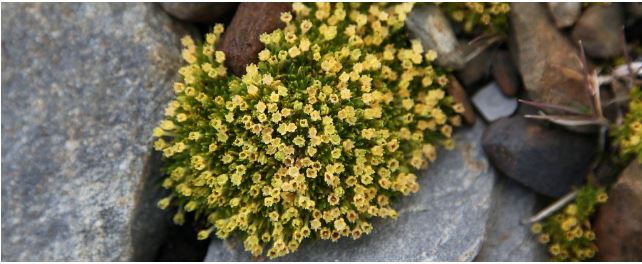
At the moment, Antarctica and its associated islands are covered by permanent snow and ice, with only a percent or so of suitable land for flowering plants like the Antarctic hair grass (Deschampsia antarctica) and the Antarctic pearlwort (Colobanthus quitensis).
In the past few decades, however, warmer springs and summers have seen such plants take off, with growth rates increasing by 20 percent or more from 2009 to 2018.
By the end of the century, some models predict there will be a threefold increase in ice-free land on the Antarctic Peninsula for plants to colonize.
If vegetation continues to spread into these zones, researchers worry it will lead to "irreversible biodiversity loss" in Antarctica.
"We know that there will be thousands of square kilometers of new-ice free area and the warmer temperatures and extra available water will create new habitats ripe for colonization, which will benefit some species and not others," explained Jasmine Lee, a conservation biologist at the British Antarctic Survey, in 2022.
"Unfortunately, the milder climates will also lower the barrier of invasion for foreign plant and animal species."
There is simply no time to stop and smell the flowers.
Scientists around the world are now working as fast as they can to understand Antarctica's past and present habitats so they can try to preserve them for the future.
Reality Of Islam |
|
A faster wa

Metal foam

By filling
 9:3:43
2018-11-05
10 benefits of Marriage in Islam
7:5:22
2019-04-08
benefits of reciting surat yunus, hud &
9:45:7
2018-12-24
advantages & disadvantages of divorce
11:35:12
2018-06-10
6:0:51
2018-10-16
12:47:1
2022-12-20
the happy life of mankind requirement
6:36:36
2022-01-25
7:59:14
2018-06-21
4:2:19
2022-10-10
7:26:19
2022-04-08
8:3:0
2018-06-21
8:15:37
2023-02-16
5:41:46
2023-03-18
| LATEST |
 HOME