الوضع الليلي


 4:49:39
 2023-08-14
 2021
Alien-Like Ocean Creature with 20 Arms Discovered Near Antarctica
Researchers trawling the ocean near Antarctica uncovered a new species that looks haunting in photos — but named it after a fruit.
The Antarctic strawberry feather star is a sea creature with 20 so-called "arms" — some bumpy, some feathery — and can altogether be up to eight inches long, Greg Rouse, a marine biology professor at the University of California, San Diego, told Insider.
Rouse co-authored the paper on the new species with researchers Emily McLaughlin and Nerid Wilson, publishing their findings in Invertebrate Systematics last month.
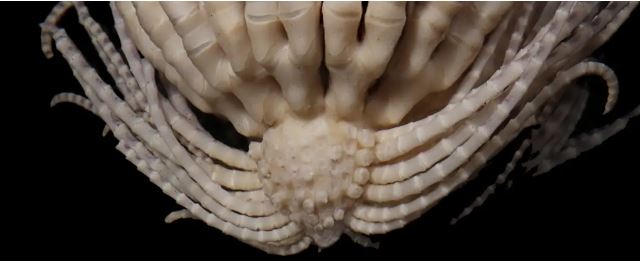
The alien-like creature does not appear to look like a strawberry at first. But if you zoom in on its body — a tiny nub at the apex of all those arms — it resembles the size and shape of the fruit.
The circular bumps on the star's body are where the cirri — the smaller tentacle-like strings protruding from the base — should be, but were removed to show the attachment points, Rouse said.
"We've taken away a bunch of the cirri so you can see the parts that they're attached to, and that's what looks like a strawberry," he said.
He added that the cirri have tiny claws at the end that are used to hold onto the bottom of the seafloor.
The so-called arms are the longer, feathery-like parts of the Antarctic strawberry feather star shown in the image. They're typically spread out, Rouse said, and help with the creature's mobility.
The formal name of the newfound species is Promachocrinus fragarius. It belongs under the class of Crinoidea, which includes starfish, sea urchins, sand dollars, and sea cucumbers, and is a type of feather star — hence the less formal "Antarctic feather star" name. Fragarius derives from the Latin word "fragum," meaning strawberry, according to the paper.
The professor said in an interview that there was originally only one species under the Antarctic feather star group — the Promachocrinus kerguelensis.
But by dragging a net along the Southern Ocean searching for more samples of these creatures, the team of scientists from Australia and the US identified four new species that can fall under the Antarctic feather star group.
The Antarctic strawberry feather star stands out in particular due to the number of "arms" it has. "A majority of feather stars have 10 arms," Rouse said.
Rouse added that the typical position of a feather star is to have the "arms" spread out and upward, while the cirri are pointed downward.
With this discovery, researchers could add eight species under the Antarctic feather star category, adding the four new discoveries and "resurrecting" previously discovered animals that were initially believed to be their own species, Rouse said.
"So we went from one species with 20 arms to now eight species — six with 20 arms and two with 10 arms under the name Promachocrinus," Rouse said.
According to the paper, the Antarctic strawberry feather star was found somewhere between 215 feet to about 3,840 feet below the surface.
Researchers acknowledged in their paper the "otherworldly appearance of the swimming motions of feather stars."
But finding new species in general is not a rare phenomenon, Rouse said, adding that his lab at the university's Scripps Institution of Oceanography name up to 10 to 15 species a year.
Reality Of Islam |
|
A faster wa
Metal foam

By filling
 9:3:43
2018-11-05
10 benefits of Marriage in Islam
7:5:22
2019-04-08
benefits of reciting surat yunus, hud &
9:45:7
2018-12-24
advantages & disadvantages of divorce
11:35:12
2018-06-10
6:0:51
2018-10-16
10:55:53
2022-06-13
4:25:57
2023-02-11
2:11:12
2022-10-15
al-hussain (peace be upon him)
10:18:1
2022-09-21
a hero waters thirsty wild animals
9:4:9
2022-01-06
allah will not answer all your prayers
6:56:28
2022-01-01
7:45:39
2018-06-21
5:41:46
2023-03-18
| LATEST |
 HOME