Hamiltonian Cycle
A Hamiltonian cycle, also called a Hamiltonian circuit, Hamilton cycle, or Hamilton circuit, is a graph cycle (i.e., closed loop) through a graph that visits each node exactly once (Skiena 1990, p. 196). A graph possessing a Hamiltonian cycle is said to be a Hamiltonian graph. By convention, the singleton graph  is considered to be Hamiltonian even though it does not posses a Hamiltonian cycle, while the connected graph on two nodes
  is not.
The Hamiltonian cycle is named after Sir William Rowan Hamilton, who devised a puzzle in which such a path along the polyhedron edges of an dodecahedron was sought (the Icosian game).
A Hamiltonian cycle of a graph can be computed efficiently in the Wolfram Language using FindHamiltonianCycle[g][[All, All, 1]][[1]] (where the cycle returned is not necessarily the lexicographically first one). All simple (undirected) cycles of a graph can be computed time-efficiently (but with a memory overhead of more than 10 times that needed to represent the actual cycles) using Sort[FindHamiltonianCycle[g, All][[All, All, 1]]]. (Note the cycles returned are not necessarily returned in sorted order by default.) Possible Method options to FindHamiltonianCycle include "Backtrack", "Heuristic", "AngluinValiant", "Martello", and "MultiPath". In addition, the Wolfram Language command FindShortestTour[g] attempts to find a shortest tour, which is a Hamiltonian cycle (with initial vertex repeated at the end) for a Hamiltonian graph  if it returns a list with first element equal to the vertex count of
  .
.
Precomputed lists of Hamiltonian cycles for many named graphs can be obtained using GraphData[graph, "HamiltonianCycles"]. Precomputed counts of the corresponding number of Hamiltonian cycles may similarly be obtained using GraphData[graph, "HamiltonianCycleCount"]..
The total numbers of directed Hamiltonian cycles for all simple graphs of orders  , 2, ... are 0, 0, 2, 10, 58, 616, 9932, 333386, 25153932, 4548577688, ... (OEIS A124964).
In general, the problem of finding a Hamiltonian cycle is NP-complete (Karp 1972; Garey and Johnson 1983, p. 199), so the only known way to determine whether a given general graph has a Hamiltonian cycle is to undertake an exhaustive search. Rubin (1974) describes an efficient search procedure that can find some or all Hamilton paths and circuits in a graph using deductions that greatly reduce backtracking and guesswork. A probabilistic algorithm due to Angluin and Valiant (1979), described by Wilf (1994), can also be useful to find Hamiltonian cycles and paths.
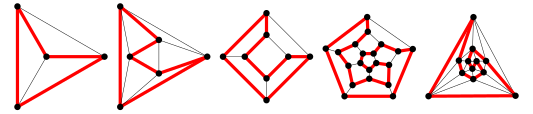
All Platonic solids are Hamiltonian (Gardner 1957), as illustrated above.
Khomenko and Golovko (1972) gave a formula giving the number of graph cycles of any length, but its computation requires computing and performing matrix operations involving all subsets up to size  , making it computationally expensive. A greatly simplified and improved version of the Khomenko and Golovko formula for the special case of
  -cycles (i.e., Hamiltonian cycles) gives
where  is the
  th matrix power of the submatrix of the adjacency matrix
  with the subset
  of rows and columns deleted (Perepechko and Voropaev).
The following table summarizes the numbers of (undirected) Hamiltonian cycles on various classes of graphs. The  -hypercube is considered by Gardner (1986, pp. 23-24), who however gives the counts for an
  -hypercube for
  , 2, ... as 2, 8, 96, 43008, ... (OEIS A006069) which must be divided by
  to get the number of distinct (directed) cycles counting shifts of points as equivalent regardless of starting vertex.
| graph |
OEIS |
sequence |
| Andrásfai graph |
A307902 |
0, 1, 5, 145, 8697, 1109389, 236702901, ... |
| antiprism graph |
A306447 |
X, X, 16, 29, 56, 110, 225, 469, 991, 2110, 4511, ... |
 -black bishop graph -black bishop graph |
A307920 |
X, X, 0, 4, 704, 553008, , 13802629632, 1782158930138112, ... |
cocktail party graph  |
A307923 |
0, 1, 16, 744, 56256, ... |
complete graph  |
A001710 |
0, 0, 1, 3, 12, 60, 360, 2520, 20160, 181440, ... |
complete bipartite graph  |
A010796 |
0, 1, 6, 72, 1440, 43200, 1814400, ... |
complete tripartite graph  |
A307924 |
1, 16, 1584, 463104, 29928960, ... |
 -crossed prism graph -crossed prism graph |
A007283 |
X, X, X, 6, 12, 24, 48, 96, 192, 384, 768, 1536, ... |
| crown graph |
A306496 |
1, 6, 156, 4800, 208440, 11939760, 874681920, ... |
| cube-connected cycle |
A000000 |
X, X, 6, 28628, ... |
cycle graph  |
A000012 |
X, X, 1, 1, 1, 1, 1, 1, 1, 1, 1, 1, 1, 1, 1, ... |
| folded cube graph |
A307925 |
X, 0, 3, 72, 23760, 332012113920, ... |
grid graph  |
A003763 |
0, 1, 0, 6, 0, 1072, 0, 4638576, 0, ... |
grid graph  |
A000000 |
0, 6, 0, ?, 0, ... |
| halved cube graph |
A307926 |
0, 0, 3, 744, 986959440, 312829871511322359060480, ... |
hypercube graph  |
A066037 |
0, 1, 6, 1344, 906545760, ... |
 -king graph -king graph |
A140519 |
X, 3, 16, 2830, 2462064, 22853860116, ... |
 -knight graph -knight graph |
A001230 |
X, 0, 0, 0, 0, 9862, 0, 13267364410532, ... |
 -ladder graph -ladder graph |
A057427 |
0, 1, 1, 1, 1, 1, 1, ... |
| Möbius ladder |
A103889 |
X, X, X, 6, 5, 8, 7, 10, 9, 12, 11, 14, 13, 16, 15, ... |
| Mycielski graph |
A307927 |
0, 1, 10, 102310, ... |
| odd graph |
A301557 |
X, 1, 0, 1419264, ... |
| permutation star graph |
A000000 |
0, 0, 1, 18, ... |
prism graph  |
A103889 |
X, X, 3, 6, 5, 8, 7, 10, 9, 12, 11, 14, 13, 16, ... |
 -queen graph -queen graph |
A307928 |
0, 3, 1960, 402364270, 39741746126749664, ... |
rook graph  |
A269561 |
X, 1, 48, 284112, 167875338240, ... |
| sun graph |
A000012 |
X, X, 1, 1, 1, 1, 1, 1, ... |
torus grid graph  |
A222199 |
X, X, 48, 1344, 23580, 3273360, ... |
| transposition graph |
A307896 |
0, 0, 6, 569868288, ... |
| triangular graph |
A307930 |
X, 0, 1, 16, 3216, 9748992, ... |
| triangular grid graph |
A112676 |
1, 1, 3, 26, 474, 17214, 685727, ... |
wheel graph  |
A000027 |
X, X, X, 3, 4, 5, 6, 7, 8, 9, 10, 11, 12, 13, 14, ... |
 -white bishop graph -white bishop graph |
A307929 |
X, X, 1, 4, 396, 553008, 4701600128, 1782158930138112, ... |
Closed forms for some of these classes of graphs are summarized in the following table, where  ,
,  , and
, and  are the roots of
  and
and  is a modified Bessel function of the second kind.
| graph |
formula |
| antiprism graph |
 |
cocktail party graph  |
 |
complete graph  |
 |
complete bipartite graph  |
 |
complete tripartite graph  |
 |
 -crossed prism graph -crossed prism graph |
 |
| crown graph |
 |
| |
 |
cycle graph  |
1 |
| Hanoi graph |
1 |
ladder graph  |
1 |
Möbius ladder  |
 |
prism graph  |
 |
| sun graph |
1 |
wheel graph  |
 |
REFERENCES
Angluin, D. and Valiant, L. "Probabilistic Algorithms for Hamiltonian Circuits and Matchings." J. Comput. Sys. Sci. 18, 155-190, 1979.
Bollobás, B. Graph Theory: An Introductory Course. New York: Springer-Verlag, p. 12, 1979.
Chalaturnyk, A. "A Fast Algorithm for Finding Hamilton Cycles." Master's thesis. Winnipeg, Manitoba, Canada: University of Manitoba, 2008. ftp://www.combinatorialmath.ca/g&g/chalaturnykthesis.pdf.Chartrand, G. Introductory Graph Theory. New York: Dover, p. 68, 1985.
Csehi, C. Gy. and Tóth, J. "Search for Hamiltonian Cycles." Mathematica J. 13, 2011.
http://www.mathematica-journal.com/2011/05/search-for-hamiltonian-cycles/.Gardner, M. "Mathematical Games: About the Remarkable Similarity between the Icosian Game and the Towers of Hanoi." Sci. Amer. 196, 150-156, May 1957.
Gardner, M. The Sixth Book of Mathematical Games from Scientific American. Chicago, IL: University of Chicago Press, pp. 96-97, 1984.
Gardner, M. "The Binary Gray Code." In Knotted Doughnuts and Other Mathematical Entertainments. New York: W. H. Freeman, pp. 23-24, 1986.
Garey, M. R. and Johnson, D. S. Computers and Intractability: A Guide to the Theory of NP-Completeness. New York: W. H. Freeman, 1983.
Karp, R. M. "Reducibility Among Combinatorial Problems." In Complexity of Computer Computations (Ed. R. E. Miller and J. W. Thatcher). New York: Plenum Press, pp. 85-103, 1972.
Khomenko, N. P. and Golovko, L. D. "Identifying Certain Types of Parts of a Graph and Computing Their Number." Ukr. Math. J. 24, 313-321, 1972.
Kocay, W. "An Extension of the Multi-Path Algorithm for Hamilton Cycles." Disc. Math. 101, 171-188, 1992.
Kocay, W. and Li, B. "An Algorithm for Finding a Long Path in a Graph." Util. Math. 45, 169-185, 1994.
Lederberg, J. "Hamilton Circuits of Convex Trivalent Polyhedra (up to 18 Vertices)." Amer. Math. Monthly 74, 522-527, 1967.
Ore, O. "A Note on Hamiltonian Circuits." Amer. Math. Monthly 67, 55, 1960.
Perepechko, S. N. and Voropaev, A. N. "The Number of Fixed Length Cycles in an Undirected Graph. Explicit Formulae in Case of Small Lengths."Rubin, F. "A Search Procedure for Hamilton Paths and Circuits." J. ACM 21, 576-580, 1974.
Skiena, S. "Hamiltonian Cycles." §5.3.4 in Implementing Discrete Mathematics: Combinatorics and Graph Theory with Mathematica. Reading, MA: Addison-Wesley, pp. 196-198, 1990.
Sloane, N. J. A. Sequences A003042/M2053, A005843/M0985, A006069/M1903, A007395/M0208, A094047, A124349, A124355, A124356, A129348, A129349, A143246, A143247, A143248, A174589, A222199, A280847, A281255, A301557, A306447, A307896, A307902in "The On-Line Encyclopedia of Integer Sequences."Tutte, W. T. "On Hamiltonian Circuits." J. London Math. Soc. 21, 98-101, 1946.
Vandegriend, "B. Finding Hamiltonian Cycles: Algorithms, Graphs and Performance." Master's thesis, Winnipeg, Manitoba, Canada: University of Manitoba, 1998.Wilf, H. S. Algorithms and Complexity. pp. 120-122. Summer, 1994. http://www.math.upenn.edu/~wilf/AlgoComp.pdf.








