Covariance
Covariance provides a measure of the strength of the correlation between two or more sets of random variates. The covariance for two random variates  and
and  , each with sample size
  , is defined by the expectation value
where 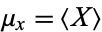 and
and  are the respective means, which can be written out explicitly as
 |
(3)
|
For uncorrelated variates,
 |
(4)
|
so the covariance is zero. However, if the variables are correlated in some way, then their covariance will be nonzero. In fact, if 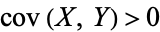 , then
  tends to increase as
  increases, and if
 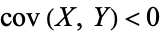 , then
  tends to decrease as
  increases. Note that while statistically independent variables are always uncorrelated, the converse is not necessarily true.
In the special case of  ,
,
so the covariance reduces to the usual variance 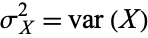 . This motivates the use of the symbol
  , which then provides a consistent way of denoting the variance as
 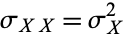 , where
  is the standard deviation.
The derived quantity
is called statistical correlation of  and
and  .
.
The covariance is especially useful when looking at the variance of the sum of two random variates, since
 |
(9)
|
The covariance is symmetric by definition since
 |
(10)
|
Given  random variates denoted
  , ...,
  , the covariance
  of
of  and
and  is defined by
where 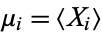 and
and 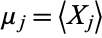 are the means of
  and
and  , respectively. The matrix
  of the quantities
  is called the covariance matrix.
The covariance obeys the identities
By induction, it therefore follows that
REFERENCES:
Snedecor, G. W. and Cochran, W. G. Statistical Methods, 7th ed. Ames, IA: Iowa State Press, p. 180, 1980.
Spiegel, M. R. Theory and Problems of Probability and Statistics, 2nd ed. New York: McGraw-Hill, p. 298, 1992.








