Teachers’ aspects about Language and Classroom Practice in Teaching Grammar
Zsanna - Perfect Tenses
Below is an extract from one of Zsanna’s lessons. This extract is characteristic of her approach to teaching grammar and I will discuss this to show how the factors impinged on her teaching.
1. For homework, the teacher had asked the students to write sentences using present perfect tenses related to some photos of people they had used in the previous lesson.
Examples of the sentences the students report are:
She has been sunbathing.
She has just put on her new contact lenses.
She has just combed her hair.
She has worn her bracelet since her boyfriend gave it to her.
2. The teacher has written out different functions of present perfect tenses in English on individual sheets of paper. She now sticks these up around the classroom (numbered 1-7) and asks the students to move round the room, to read the functions, and to decide which function each sentence they wrote for homework goes with.
The functions were as follows:
Actions/events that have already happened.
Actions/events that have happened for the first, second, last time.
Actions/events that have been happening for some time.
Actions/events that have just happened.
Actions/events that have been happening since a particular time or event.
Actions/events that have happened in a period of time that links the present to the past.
Actions/events that have not happened yet.
The students move around for a few minutes trying to match their sentences to these functions.
3. Then they sit down for a general discussion in which the teacher elicits an example of each function. The students do not suggest an example for function 2, so the teacher writes on the board:
This is the first time she has driven a car.
That’s the tenth time she has visited London.
4. The teacher now draws a map of the perfect tenses in English on the board, eliciting from the students the information to place in it. The completed diagram looks like this:
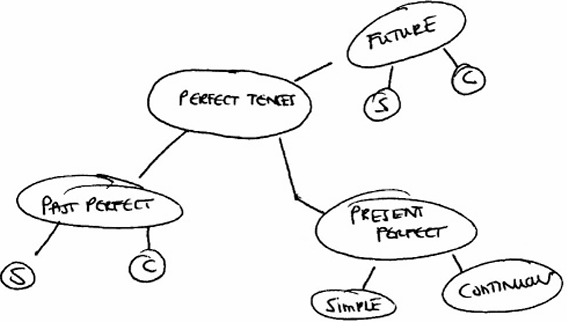
5. The teacher now gives the students a list of sentences (e.g. By this time next week I’ll have been studying for my exams for 2 months) and asks them to match them to this diagram. The students work on this in groups, identifying which of the perfect forms each sentence illustrates. They take a few minutes to do this.
6. In groups, the students are then asked to compile everything they know about perfect tenses in English. The teacher elicits from the students what this will involve and together they establish that students should think about the form, when to use it, examples, and common expressions or related words. The students engage in this task, and the teacher circulates and discusses with them as they do.
7. For homework, the students are asked to look at pp. 71-72 of their course book, where a summary on perfect tenses is given, and to compare the notes they made during today’s lesson to the information provided there. The teacher asks the students to make a note of any questions they want to ask and to bring them back next lesson.
This lesson highlights several typical features of Zsanna’s approach to teaching grammar. Firstly, there is a high level of explicit talk about and analysis of grammar. This reflects the teacher’s own experience of language study; however, her decision to approach grammar in this way was not simply the unquestioning adoption of the strategies she had experienced as a learner; she did in fact go through a phase earlier in her career where she avoided explicit grammar work altogether and attempted to implement what she called a ‘communicative’ approach. However, after experimenting with this approach for a while she had decided that an element of explicit attention to grammar was beneficial for her students, especially with areas, such as the perfect, where Hungarian did not have equivalent concepts. In such cases, as the teacher recalled from her own learning experience, formal study was a useful way of enabling learners to develop their KAL. As she explained, “Yes, definitely I try to use my experience and that is why non-native teachers have advantages because they just learnt from the same steps on their own”.
This lesson also illustrates typical processes which she engaged students in. Thus, she encouraged students to generate their own examples, and to analyze and to classify these. She also regularly engaged them in brainstorming group activities where the goal was to review what they knew about a particular issue and to generate questions for further research. Students would then be asked to follow up these questions by reading their course book or using reference materials in the library. As we saw earlier, the intensive study of grammar books was a strategy the teacher herself had found helpful in developing her own KAL.
As already noted, the perfect was an area of the grammar which the teacher admitted she still occasionally had problems with, and one she knew her students found challenging too. Nonetheless, as the lesson shows, she was willing to engage in an open discussion of this topic with her students and to encourage them to generate and analyze examples and to ask her about these. This reflected her belief that having an adequately developed KAL is less about always knowing the answer when students ask questions and more about knowing that there is always more to learn:
basically it is not about knowledge, basically it is about your attitude so you simply can’t do that, you just come across some things that you don’t really know and you don’t go after it or you don’t consult anybody or anything about it. So you just can’t stop developing.
In fact Zsanna commented several times in our discussions that she encourages students to ask her questions even though the unpredictability this generates can make her vulnerable:
there are always questions that students might ask and you don’t know the answer or you don’t know the answer in the way they require it....I am really happy and that is why I came to this school because I wanted to be challenged in this way, so I used to teach in...[other schools] ... and I just didn’t have the possibility to develop. I wasn’t motivated by students so I really like that sometimes my students bring some questions ... I really like that sometimes ... I have the possibility to discuss things and I very often say to them that I don’t the know answer or I know something about it but I would like to check it.
These opportunities for continued learning are very important for her:
you very easily can be lost into your daily routine and you need these celebrations of your mind, then you can deal with something that challenges you ....You have to discover these little points and you can entertain you brain.
She was keen to help her students understand the logic of English grammar, especially where this contrasted with Hungarian, and believed that the kind of activities she did in the lesson above would help them develop the overview of the perfect they required in order to make full sense of it. She described the process she hoped to facilitate in her students as follows:
we have to excavate behind the sentence, we have to find a meaning, the logic in it then we have to put it away, digest a little bit and then very slowly we start to feel comfortable. We have to feel it somehow.
One final point reflected in the lesson above relates to the teacher role Zsanna generally adopted. She saw herself as a ‘conductor’ who preferred to stay in the background. She aimed to set up activities through which students could become aware of what they knew about a particular area of grammar and, consequently, through which they could identify the problems and the questions they needed to address. Her stance was based on the belief that “you won’t remember it [someone else’s explanation] for a long time then you discover something for yourself then you think something over and you come up with a solution all together with a group of students and it, you might keep it for a longer time”. This belief was derived from her own experience of learning, as well as from experience of seeing how students were not interested in her explanations if she had not first given them the chance to identify their problems. In contrast, her approach created a context in which, she explained, students “could see grammar as a problem they definitely had to discuss. They really like discussing things and they really love arguing about things and that is why, because it was a problem to be discussed”. Again, here we can see Zsanna mirroring in the classroom the processes of independent discovery she had found useful in developing her own KAL.








