Realization(s): Systemic-Functional Linguistics and the Language Classroom
SYSTEMIC FUNCTIONAL LINGUISTICS
Changing practices, changing KAL
There is a noticeable shift over time in the way Sandra’s knowledge and application of SFL develops. Before the first lesson she described her grammar aims:
Ah well, today we are doing relative clauses as the grammar point, one of the things we are going to deal with are relative clauses ... [it] will be related to all the other activities, like such things as nominalization because they all have to do with the way of giving them help in how to write an essay.
An extract from lesson one typifies her teaching practice, within the syllabus constraints already discussed, at the beginning of the research. The grammar point she was required to teach was subordinate clauses. The sample sentence was Even a good attractively priced product that satisfies a need has to be made known to its target customers:
T: (stops writing on board) OK, so we have the main verb. Which did you say that was the main verb?
L: has to be made known
T: has to be made known [writing on board] OK this is the main verb...and which one was the subordinate clause
L: um product that clearly satisfies the need
T: is product included in the subordinate clause?
L: no, that...
T: that, exactly. This is the subordinate clause and the verb of the subordinate clause is?
L: satisfies
T: satisfies, OK, so ahh, the main clause would be the whole and the subordinate clause is this one. In this case, it’s a special
subordinate clause, it’s a relative clause because it functions as an adjective, it has an adjectival function. Aah if you have
a look at it in a way this clause is talking about what?
L: product
T: the word product, so we can say that product is the antecedent, we call it the antecedent. Yes, so because the whole clause
refers to this word.
In this extract, Sandra uses a didactic style, focusing on syntactic explanations. She later commented on how this style contrasted considerably with her belief that grammar teaching should be inductive and contextualized. Here, she works mainly with terms and concepts from traditional structural grammars (see Derewianka, 2001). Despite her wish to focus on contextualization and meaning, this is not reflected in this extract. She subsequently commented on this herself, while also explaining that she felt very short of time:
Generally with grammar I take a longer time um and generally I take examples from things that they’re doing and first, yes, it has to be contextualized and then this one was not a good example of it but generally I take it from what we’re doing, a text.
At this point it appears that Sandra is struggling to reconcile the traditional grammatical knowledge gained in her previous training with the SFL concepts presented in her Masters course. While she seems to feel comfortable with the notion of text, she is unsure about how to link text and grammar:
I: Did you draw on some of the things we covered in your thinking about how you were going to present this in the
classroom?
S: It’s easier to grasp when working on text...but I think I feel that I need some more information you know to put this into
practice...especially with functional grammar but...with text...yeah, I still don’t know how to use this may be with
grammar items... I’m sure that the things that I’ve learned or the things that are inside me will come out...but there are
things that I still have to work on.
I: Are you aware of any conscious ways that you use [SFL]?
S: Well as I was saying maybe the way I dealt with essays...like describing or getting them to identify the different stages
ah that is something that is changing and especially because before I didn’t teach how to write essays so that’s great.
Sandra began to reflexively deconstruct her knowledge about SFL. As she talked she highlighted several ways she could begin to utilize what she had learned. She saw the advantages of SFL as providing a whole framework of language, rather than parts, enabling students to remember structures in context, and helping students to structure essays. She believed the grammatical systems associated with field (participants, processes and circumstances) were an area where she could extend her practice. At the same time, she characterized SFL theory as an overwhelming and complex model with many unfamiliar terms. She stated that she needed much more exposure to the theoretical ideas of SFL, more time to understand the grammar and to undertake change processes in her teaching.
In the subsequent lessons, she was teaching an intermediate General English class. Sandra’s focus in lesson two was on the simple past and past continuous tenses, but she taught this within the context of a news story. Previously, she had presented a ‘scripted’ news story from a textbook and in the lesson now being observed wanted the students to work in groups to produce the schematic structure of a news story. After this, they would write their own news stories. After the lesson, Sandra observed that this was her first attempt to use functional grammar in her teaching and that it resulted from our discussions following lesson 1.
I: So you said this is the first time you’ve tried to apply [SFL] and was that a conscious decision?
S: Yeah, because I said to you before I want to start applying that but I need to do it gradually because I don’t
feel I’m well prepared to start all of a sudden so yes, I think that I’ll be taking things like this. I think that in a
way it will help their understanding or help them grasp the concepts in a better way, in an easy way.
In her descriptions of the grammar she had taught she was beginning to use more of the metalinguistic terms associated with SFL, such as circumstances and recount. However, she was still relying on textbook materials that were essentially based on traditional grammatical structures rather than on text. Nevertheless, here the solely syntactical focus evident of the first lesson has been extended to include semantic features of the text.
The third lesson illustrates how she was increasingly attempting to integrate grammar with text, as well as to use more authentic texts based on students’ experiences. The lesson focused on constructing a recount of an excursion the students had undertaken the previous week. Before the students wrote, Sandra spent considerable time scaffolding the schematic structure of the recount, eliciting the events the students had experienced and the grammatical patterns they could use to write about these events. She then redirected their attention to a recount based on an earlier excursion as a model for their writing:
[S = Sandra; L = Learner]
S: You mentioned that you need to include the times, so we’ve mentioned last Monday. What other words include time?
L: early in the morning
S: early in the morning. Which other?...
L: then
S: Yes I know but then I’ll talk aboul that in a second
L: after 5.30
S: Yes, after 5.30. OK. Right what about then. What do you think, what is the function of then? Is it giving you the time?
L: No... continuing
S: Continuing, you say what happened first, and then this happened... So we have then like a connector in a way-then
connects the sentences. Any other words that connect the sentences?
L: while
S: while... Is there any other word that in a way connects that’s very simple
L: and
S: and - Can you find any place where it connects two events?
L: We left there at 8am and arrived in the mountains.
S: OK very good. Thank you. What about this word? Words such as which, where....It says walked through the bush where we
saw some brightly coloured Australian birds, so where is what?
L: What you did there
S: Yes, you say what you did there. What about which? Are we saying what we did at Govett’s Leap or are we describing it?
L: If we want explain
S: OK, exactly. Explaining the noun. You give information about this, so we don’t know what this is so we have an explanation
which is a lookout. So these are the sort of things you can find in a recount. You can find the places and you can find time,
the different times when you did different things and if you want to explain something about a place you can use which
and give the explanation or if you want to explain what you did at that place you can say where...
Sandra’s perception was that she was gaining confidence and successfully beginning to use grammatical instruction in a more textual and contextualized way:
Yeah, in this one relative clauses came up but it was more natural and more spontaneous...because we were talking about recounts and so we were analyzing one in particular, so they were looking at things related to time or um I guess place...so obviously it’s getting them to recognize why that ‘which’ is there, what the clause is doing, what the relationship is between the clause and the noun that is before it.
She spoke about her growing confidence in using SFL and her sense that her reflections had led to a substantial shift in her teaching practice over these three lessons:
I think that it helped me become more as I said conscious about or more confident with this new approach... Because as I said to you at the beginning I felt like I really did not know how to put this into practice so um...the first lesson you came to see the way it was out of control in that sense at that stage um so it helped me see how I could put that into practice...getting the questions from you that would make me think so...
And later
S: When I think of having taught essays in the past...I didn’t get into it that much in the sense of really taking
every single thing of a model
I: Do you mean the structure or the grammar?
S: Could be the grammar, the structure, yeah both things...it’s totally changed the way I look at that now...For
instance when I explained how to write a recount, how to write a news story the way I did that was different
from the way I would have done it before. I wouldn’t have spent so much time looking at the different
aspects because I never thought of it that way.
Overall, there is obvious movement over these lessons away from decontextualized grammatical explanation, with the primary focus on syntax and constructed textbook samples, towards the use of authentic text, text modelling and joint text construction with the students. Sandra appears to feel more confident in using some of the main pedagogical approaches associated with SFL and genre theory, although her major applications still relate to text structure and the grammar of field. Nevertheless, her growing insights provide her with a base from which to go on. In her final interview she noted:
What I’m now using, I believe in now, so definitely to go from the context, the bigger thing to the individual thing... taking that context into account not just to teach something, like isolated from the rest... As I said before, every little thing is for a purpose, so trying to get them to find out what the purpose is ... why these things are said in that way.
This comment reflects Sandra’s new understanding of the relationships between the contextual, textual and lecixogrammatical levels of the theoretical model illustrated in Figure 1 in “in LEARNING TO TEACH LANGUAGE THROUGH CONTENT” , and what this might mean for the classroom.
Bobbi
Before our first observation, Bobbi described the class she was teaching.
So I suppose the aim of Further Studies is to create an academic framework for them - learning how to do research, learning basic essay types plus attendant sort of grammar skills and also study skills ... So my personal aim has been to try and meet their individual needs which is not easy ... You can’t easily walk around the classroom, you can’t easily break them into groups and there’ve been strong personality clashes.
In the first lesson, from which the following extract was taken, Bobbi’s grammar focus was phrasal verbs. The extract shows her giving an unplanned grammar explanation. The students had completed an activity where they were given a grid with prepositions and verbs, and they had to decide which combinations were and were not possible; this was followed by a teacher-led class discussion on the students’ responses, the possible phrasal verbs and their meanings.
B: There’s, sometimes you have phrasal verbs where you have an object after it where you keep going after you’ve made,
you’ve given your phrasal verb which we, the name for it is ... is transitive which is ... which means when you have a sentence
where you have like a subject, a verb and an object so let’s see if we can make one up....like I ... somebody says, ’have you
found your book? ‘I wasn’t looking for my book. I wasn’t looking for it.’ So Where’s your phrasal verb there?
L: wasn ’t looking for
B: wasn’t looking for - right. That’s your phrasal verb and here your subject is ‘I’ and what is the object of the sentence here?
L: book
B: So here there is an object. So quite often we do that but sometimes we actually don’t. Sometimes we say um something
like, ‘would you like to come around?’ So here there is no object. It’s understood that what you mean ‘come around to my
place’ or something like that but often we don‘t say it. We say, ‘would you like to come around?’ um and this is called
intransitive. This is when, when the sentence doesn’t have an object it just ends with your phrasal verb.
Bobbi reported later that she was constructing her understanding of this particular grammar point ‘on the run’ as it were.
I know even reading it through it’s when I’m actually thinking very rapidly like, ‘which way will I go? what will I do now? um do I pick this up?’ Yeah and I’d say that those ‘ums’ there represent me sort of deeply thinking about, ‘do I know what an intransitive verb is? Let me just think for a second’.
Like Sandra, Bobbi stated that grammar should be taught in context. In discussing the above extract, we asked Bobbi whether and how she would have followed this particular grammar point up in subsequent lessons.
B: I tend to recycle information and refer back all the time but um in a more formalized way I mean I probably have to sit
down and really think about it. ... But I think, I think um...in most of my teaching I don’t actually teach sort of pure grammar
at all. I tend to teach it very much in context in terms of what it is that we’re doing and...yeah like...connectives or you
know-
I: So it’s connected to the activity?
B: Very much to the um activity and particularly so at the lower levels too because um we’ve really got here at [the language
centre] it’s very different because you’ve got sort of people with fairly strong academic frameworks whereas there [teaching
adult migrants] often they don’t have formal frameworks at all. And um...yeah and I just find that if I get into the rarefied
area of grammar their attention span is fairly short so I tend to use applied grammar if you like. [laughs]
In this lesson, the grammar point, and grammar explanation in the extract were largely conceived and explained in terms of traditional grammar. Bobbi outlined the grammar explanations in terms of the grammar focus of the lesson and the ensuing activities, rather than in terms of target texts or specific social situations.
It seems that at this early stage of the research, Bobbi was struggling to find practical classroom applications of SFL, perhaps partly as a result of her ongoing struggle with its theoretical complexity, and with teaching grammar in general.
I very often actually learn as I teach ... For me it’s actually, I’ve learnt a great deal of grammar just through teaching because you know you come up against a problem you have to think about it and then you go away and you read about it and then you come back in a more prepared way but I’m finding students are always throwing up stuff I can’t answer or can only partly answer.
In the three subsequent lessons, Bobbi taught a course for students preparing to enter university. After this initial follow-up interview where we asked her about using SFL, Bobbi showed a shift of perspective on language and grammar.
In the first of these subsequent lessons, Bobbi worked with the students to examine the construction of cohesion through lexical chains in a text written by one of the students.
B: Then we’ve got country and once again the sentence that starts off with country. The country is a good place to live. So
country and then you’ve got, It’s a place for people to live. And then you’ve got, There are many natural things. And you’ve
got, actually we do place again in a different color you get the word place repeated again here ... and, It’s a beautiful place.
So can you see any other similar sorts of words?
L: Many people go to the country.
B: Many people go to the country. So you’ve got country here again and then you’ve got and again and then you’ve got
L: last one [laughs]1
B: [laughs] So we’re using repetition of the word country a lot. So you see that helps to...to glue that paragraph together too
because you’re repeating that word so that you know that’s what we’re talking about.
Together, teacher and learners constructed the table below on the white board as the different lexical chains were marked in color on the text on an OHT. The learners then worked on three additional short learner texts to examine them in the same way for cohesive devices (including pronominal reference). The learners then worked in pairs and groups on a longer, model text provided by the teacher. This activity was done in preparation for a subsequent lesson where learners were required to write a short response to an essay topic.
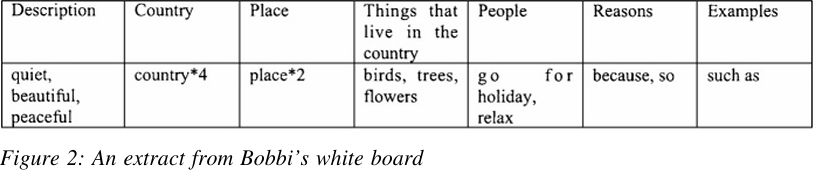
The parallels with Sandra’s second lesson in terms of the approach to grammar and pedagogy are clear. Bobbi developed the lesson using the learners’ texts from a previous lesson, and also by adapting SFL-based materials. Her decision to take this approach was based partly on the set syllabus for the course, but also partly from her own assessment of the students’ needs.
I just thought that perhaps if we started ... looking at cohesion and getting them thinking about the flow of their sentences. We’re saying, you know, your paragraphs should develop the information but we also need to know that the information is cohesive. Like I mean we’re half doing that by saying you have argument one and then argument two but you’re still looking at it on a macro level and I thought perhaps we should turn around and look at it on a micro level.
It was immediately after this lesson that our roles as observers and her role as subject was commented on by Bobbi.
You know because I had to present a lesson to you I put in the work that I probably otherwise wouldn’t put in to quite this degree ... I mean I think I was much more careful in the way I presented it and also as I say there’s positive feedback to this because now I’ve planned in a sense.
At this point, then, a shift in Bobbi’s practice was occurring because of our presence. This was also a noticeable aspect of the changes in Sandra’s practice. While the new KAL the teachers learned in our course did not seem alone to have had a significant impact on their teaching practices, when combined with our presence in their classrooms, as researchers investigating the implementation of that new knowledge, it did. This is consistent with the experiences of educational linguists working in the N.S.W. Disadvantaged Schools Program’s primary-school Language and Social Power Project, and the secondary-school Write it Right Project from 1986-1996I. They found that in addition to teaching SFL theory and the innovations in curriculum and pedagogy it inspired, it was necessary for consultants to spend time with teachers in their classrooms if they were to adapt their practice (Jim Martin, personal communication, October 31, 2002). The issues this raises for us as teacher trainers, for our students, and for our understanding of the nature of KAL, are pursued in the discussion section.
In discussing the application of SFL in the classroom, Bobbi found it difficult to pinpoint specific changes in her teaching. Nonetheless, it is certainly possible to recognize its influence in the following extract from the third lesson.
B: What does it do? ... What words come to mind?
L: Relationship.
B: Hmm?
L: Relationship.
B: Relationships yes relationships but they are ... they’re relating to each other, one, another, yes. So you could say that they
are showing a relationship ... it’s also ... ordering isn’t it? One, another, so there’s some sense of order ... and ... you were
thinking about this ... in terms of mathematics in terms of thinking about it sort of mathematically, what are we doing?
L: Just the first sentence, then the second sentence
B: It’s like... like adding.
L: Yes
B: It’s adding information so this one would be we’d call it additional ... so one, another, furthermore,. We’re just moving
progressively one two three, so it’s order, it’s addition, and it’s um relational - they’re relating to each other. Okay. With
the others that are left do they belong together or ... which might belong together there?
L: on the other hand and however
B: That’s right, on the other hand and however ... belong together. What d what are they doing?
L: Contrast.
B: They’re contrasting. Very good ... so these are acting as a contrast...so knowing that we’re changing quite significantly.
What does therefore do?
L: because
B: because. Yes. It’s
Ls: so, so
B: so, yeah, therefore, so, because...what do they do?
L: Result.
B: A result. They’re giving showing...result. ... Causes leading to effect. ... Because sometimes in writing we know these words
but sometimes we don’t actually quite know the um the meaning. Quite a lot of people for example will put on the other
hand without having put the first, the first hand first, the first piece of information.
In contrast to the first lesson, Bobbi worked with a model text of the type the learners were expected to produce in their major assignment to identify functional elements of the grammar. This was in response to problems she had identified in their writing:
In this particular major assignment they actually have to be able to recognize a particular essay type. They have to be able to, I suppose write topic sentences, work out what your main arguments are going to be and how to support it and so both the cohesion lessons and then the transitional um signals and so forth was actually trying to give them the skills...Like they learn the howevers, on the other hands, but they don’t have any concept that you know that if you have one hand you’re going to have another hand which means a balanced argument so it was trying to build up those skills.
This lesson extract demonstrates that Bobbi reflected on a number of the pedagogic practices she discussed during the research: teaching grammar in a contextualized manner, teaching grammar in response to the needs of the task and the students, and recycling grammar throughout a course.
Additionally, her approach here appeared to be informed by a text-based, functional view of language. During the research, Bobbi specifically mentioned text cohesion (conjunctions and lexical chains) as elements of functional grammar which she had consciously incorporated into her teaching of grammar (other elements she also mentioned were the Theme/Rheme structure of clauses and clause complexes, nominalization, and the structure of verbal groups). These observations were borne out by Bobbi’s fourth lesson, where the language focus was on the use of modal verbs in academic writing. For this lesson, Bobbi had prepared worksheets, chosen a grammar focus directly relevant to learners’ immediate and long-term interests with clear relevance to the feedback on their first assignment, and done so from a text-based, functional perspective on grammar consistent with the principles of SFL.
Bobbi’s final three lessons showed that she could identify the needs of her students and implement a pedagogic plan of action which appeared to be informed by the concepts of SFL. Yet, she still found it difficult to articulate a specific relationship between her understanding of SFL and her teaching of grammar.
I mean there’s a lot that I’m using but I’m not using it in a very conscious [way]. SFL - it’s just sort of you’ve got a bag of useful items and, so I mean, certainly the idea of... using context as the basis and then... the three levels of relationship [field, tenor and mode] and, you know, whether you’re writing or speaking, I mean all that has become the absolute basis of the way I think.
1 The last word in the text is “country”; the student learner is referring to this.
I N.S.W. (New South Wales) is one of the six Australian states.








