FRICTION RIDGE PATTERN VISUALIZATION TECHNIQUES
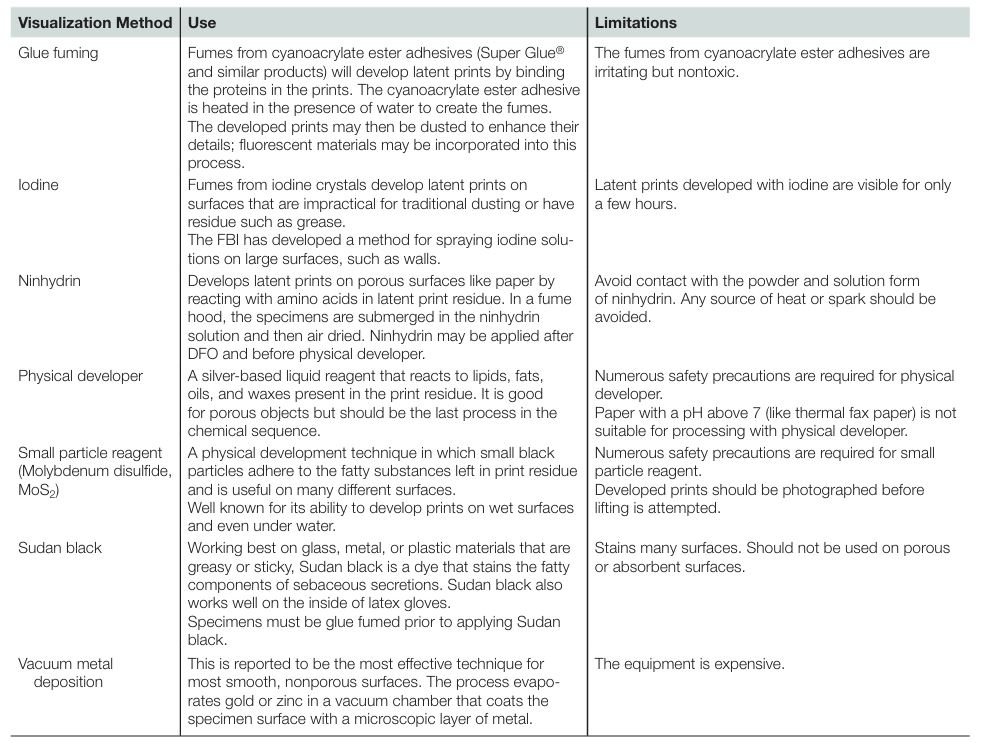
Not all friction ridge patterns are patently obvious and some require physical, chemical, or optical enhancements to make them visible. The oldest and still most common method is to use one or more fingerprint powders to create contrast between the ridge pattern and the background. These powders typically are available in black, white, and other colors, including metallic. Black is the most popular color because it creates the most contrast on a white card, commonly used for filing and recording friction ridge prints. This provides a uniform medium for the comparison of black ridges of the questioned print to the black-inked ridges of the known print. For photography, however, other colors are of considerable use, especially against the variety of colored backgrounds found in homes, offices, and cars. Once photographed, the prints can be lifted and placed on a black background card for further contrast. Some companies produce powders with two contrasting colors in them, like black and silver, to provide contrast regardless of the background. Magnetic powders, finely ground magnetic metals, work best on coated or shiny surfaces. Additionally, many fluorescent powders have been developed that fluoresce at specific wavelengths for easy visualization with tunable light sources and special film. The powders are applied with a soft fiberglass brush that has long, very fine bristles, as shown in Figure 1; some examiners use brushes with natural bristles (usually squirrel or camel hair), but these are rare today. The brush is dipped into the powder and gently applied to the latent print with a light touch; it is very easy to stroke too hard and remove latent print evidence. Magnetic powders require a special magnetic applicator that picks up a “fuzzy ball” of magnetic powder that is then “brushed” over the print. The print is then photographed and/or lifted with frosted or clear tape for mounting on a contrasting background card. Information about the print—where, when, and how it was lifted and by whom—is also recorded on the card, along with an identifier for chain of custody and reference purposes. Many other chemicals and processes have been developed for the visualization of latent prints, some of which are listed in Table 19.1. Visual detection methods have the advantage of being nondestructive; therefore, these techniques do not prevent applying conventional fingerprint development methods afterward. Three main types of lasers have been used to detect finger prints: the argon, the copper vapor, and the neodymium-yttrium/arsenide/gallium (Nd:YAG) lasers. These lasers have been shown to work well on metal surfaces, skin, and some plastics. The item of evidence should be illuminated with different wave lengths of light while observing the object through filtered goggles designed for the wavelengths used.

FIGURE 1 Fingerprint powders are applied with brushes that have very fine, long bristles.
Table 1 Various Methods of Visualizing Latent Prints and Precautions—cont’d