0
EN
1
المرجع الالكتروني للمعلوماتية

Grammar

Tenses

Present

Present Simple

Present Continuous

Present Perfect

Present Perfect Continuous

Past

Past Simple

Past Continuous

Past Perfect

Past Perfect Continuous

Future

Future Simple

Future Continuous

Future Perfect

Future Perfect Continuous

Parts Of Speech

Nouns

Countable and uncountable nouns

Verbal nouns

Singular and Plural nouns

Proper nouns

Nouns gender

Nouns definition

Concrete nouns

Abstract nouns

Common nouns

Collective nouns

Definition Of Nouns

Animate and Inanimate nouns

Nouns

Verbs

Stative and dynamic verbs

Finite and nonfinite verbs

To be verbs

Transitive and intransitive verbs

Auxiliary verbs

Modal verbs

Regular and irregular verbs

Action verbs

Verbs

Adverbs

Relative adverbs

Interrogative adverbs

Adverbs of time

Adverbs of place

Adverbs of reason

Adverbs of quantity

Adverbs of manner

Adverbs of frequency

Adverbs of affirmation

Adverbs

Adjectives

Quantitative adjective

Proper adjective

Possessive adjective

Numeral adjective

Interrogative adjective

Distributive adjective

Descriptive adjective

Demonstrative adjective

Pronouns

Subject pronoun

Relative pronoun

Reflexive pronoun

Reciprocal pronoun

Possessive pronoun

Personal pronoun

Interrogative pronoun

Indefinite pronoun

Emphatic pronoun

Distributive pronoun

Demonstrative pronoun

Pronouns

Pre Position

Preposition by function

Time preposition

Reason preposition

Possession preposition

Place preposition

Phrases preposition

Origin preposition

Measure preposition

Direction preposition

Contrast preposition

Agent preposition

Preposition by construction

Simple preposition

Phrase preposition

Double preposition

Compound preposition

prepositions

Conjunctions

Subordinating conjunction

Correlative conjunction

Coordinating conjunction

Conjunctive adverbs

conjunctions

Interjections

Express calling interjection

Phrases

Sentences

Clauses

Part of Speech

Grammar Rules

Passive and Active

Preference

Requests and offers

wishes

Be used to

Some and any

Could have done

Describing people

Giving advices

Possession

Comparative and superlative

Giving Reason

Making Suggestions

Apologizing

Forming questions

Since and for

Directions

Obligation

Adverbials

invitation

Articles

Imaginary condition

Zero conditional

First conditional

Second conditional

Third conditional

Reported speech

Demonstratives

Determiners

Direct and Indirect speech

Linguistics

Phonetics

Phonology

Linguistics fields

Syntax

Morphology

Semantics

pragmatics

History

Writing

Grammar

Phonetics and Phonology

Semiotics

Reading Comprehension

Elementary

Intermediate

Advanced

Teaching Methods

Teaching Strategies

Assessment

قم بتسجيل الدخول اولاً لكي يتسنى لك الاعجاب والتعليق.

Hierarchies among lexical items

المؤلف:  THOMAS G. BEVER and PETER S. ROSENBAUM

المصدر:  Semantics AN INTERDISCIPLINARY READER IN PHILOSOPHY, LINGUISTICS AND PSYCHOLOGY

الجزء والصفحة:  589-33

2024-08-27

1514

+

-

20

Hierarchies among lexical items

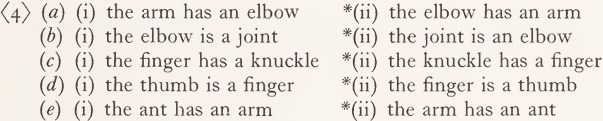
Not all semantic phenomena can be handled by binary features, even if those features are related in a class-inclusion hierarchy. Consider the sentences in (4). Why is it that the sentences on the right are grammatically deviant? It is not simply the case that they are counterfactual, since (4 ei) is counterfactual, but does not involve the same kind of violation as (4 eii). The first doesn’t happen to be true; the second couldn’t possibly be true.
 

These facts justify the assumption that lexical entries are themselves arranged in two simultaneous hierarchies: one represents the inalienable inclusion of Have, and the other represents the class membership of Be. In (5) the solid vertical lines represent the Have hierarchy and the dotted horizontal lines represent the Be hierarchy. [We use the convention that the subject of an inalienable Have sentence must dominate the object in this tree, and that the subject of a generic Be must be dominated by the predicate object. Thus we can say, ‘the body has an arm’, ‘the arm is a limb ’, but not the reverse.]
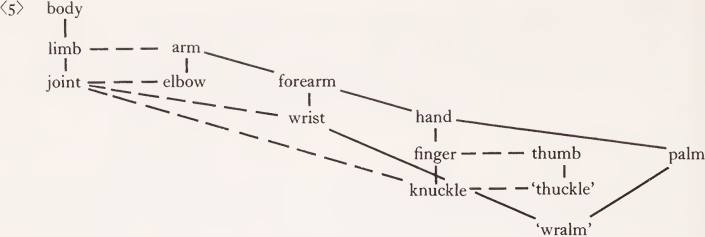
 

Figure )5( demonstrates why it is the case that semantic features with a limited number of states cannot handle these relations and block the kinds of incorrect sentences on the right in (6) a body has an arm an arm has a forearm a forearm has a hand a hand has a finger a finger has a knuckle Figure )5( allows the sentences in )6):
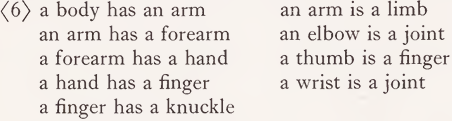
Any reversal of the nouns in these sentences would produce a deviant sentence, so that just to handle these cases a binary feature analysis would require six states.


It is clear that we must distinguish between lexically permanent hierarchies as in (5) and the productive use of ‘have’ and ‘be’ in actual sentences. Thus the fact that we can say ‘ the tree is nice ’ and ‘ a tree has importance ’ does not necessarily require a corresponding lexical hierarchy. Such sentences with ‘ Be ’ and ‘ Have ’ are ‘ productive ’ (or alienable) uses of Have and Be rather than the ‘ lexical ’ (inalienable) use exemplified in (4) and (6).


اخر الاخبار

اشترك بقناتنا على التلجرام ليصلك كل ما هو جديد

