الوضع الليلي


 1:13:18
  2025-12-22
  2302
2302
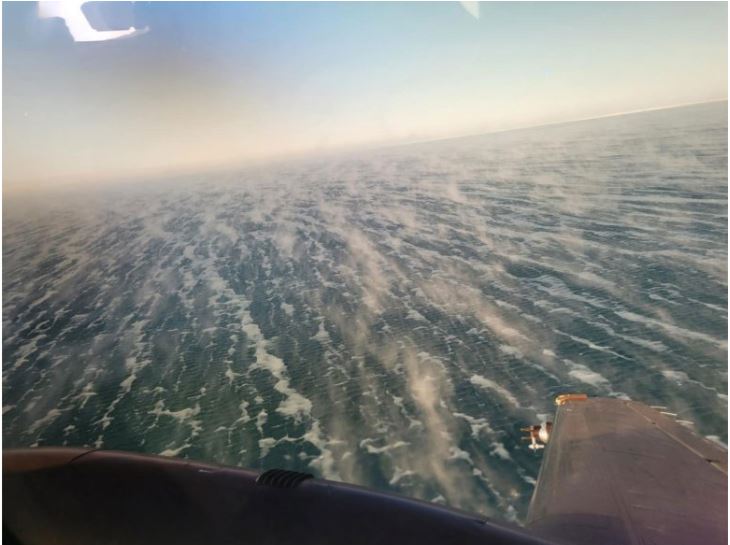
Researchers report that oil-field emissions are reshaping regional atmospheric processes.
Earth’s climate is shifting rapidly, with the most dramatic changes occurring in polar regions. A team of researchers from Penn State has taken a close look at the Arctic atmosphere and uncovered a complex set of chemical processes that influence how the region is changing.
To conduct the study, scientists relied on data gathered during a two-month field campaign that combined measurements from two research aircraft with observations taken on the ground. This effort allowed them to compare atmospheric chemistry in two Arctic locations and in the largest oil field in North America with nearby, less disturbed areas.
From this work, the researchers identified three major findings. They determined that gaps in sea ice, known as leads, play a major role in shaping atmospheric chemistry and cloud development. They also found that emissions from oil extraction significantly change the chemical makeup of the surrounding air. Together, these influences create feedback processes that speed up sea ice loss and intensify warming across the Arctic.
The study was recently published in the Bulletin of the American Meteorological Society.
Understanding Arctic Chemistry Through CHACHA
The research was carried out as part of a broader collaboration known as CHemistry in the Arctic: Clouds, Halogens, and Aerosols, or CHACHA.
This multi-institutional project, led by five research organizations, focuses on how chemical reactions evolve as air near the surface rises into the lower atmosphere. These changes drive interactions between moisture, low-level clouds, and pollutants that are critical to understanding Arctic climate behavior.
“This field campaign is an unprecedented opportunity to explore chemical changes in the boundary layer — the atmospheric layer closest to the planet’s surface — and to understand how human influence is altering the climate in this important region,” said Jose D. Fuentes, professor of meteorology in the Department of Meteorology and Atmospheric Science and corresponding author of the paper.
“The resulting datasets are producing an improved understanding of the interactions between sea-spray aerosols, surface-coupled clouds, oil field emissions, and multiphase halogen chemistry in the new Arctic.”
To study the chemistry of the boundary layer of the Arctic, researchers sampled air over snow-covered and newly frozen sea ice in the Beaufort and Chukchi Seas, over open leads and across the snow-covered tundra of the North Slope of Alaska, including the oil and gas extraction region near Prudhoe Bay. The campaign was conducted out of Utqiaġvik, Alaska, between February 21 and April 16, 2022, shortly after the polar sunrise — a period of continuous sunlight following two months of darkness — when the increased UV rays intensify the chemical changes at the surface and in the lower atmosphere.
Sea-Ice Leads and Atmospheric Feedbacks
Researchers found that leads — ranging from a few feet to a few miles wide — created intense convective plumes and cloud formations, while lofting potentially harmful molecules, aerosol pollutants, and water vapor — all things that can contribute to warming the climate — hundreds of feet into the atmosphere. These processes accelerated sea-ice loss by forcing even more convection and cloud formation, which increased moisture and heat transfer and led to the formation of even more leads, Fuentes said.
The team identified another feedback loop on land, with chemicals found in the saline snowpacks along the coast reacting with the emissions from the oil field. During the CHACHA campaign, researchers specifically observed bromine production along saline snowpacks — a phenomenon unique to polar regions.
These bromine molecules rapidly depleted ozone in the boundary layer, creating another feedback loop that allows more of the sun’s rays to reach the surface, warming the snowpacks and releasing more bromine.
Industrial Emissions in a Pristine Region
Additionally, during the field campaign, researchers found massive boundary layer changes over the Prudhoe Bay oil fields. Gas plumes from the extraction area reacted in the lower atmosphere, acidifying the air mass and producing harmful substances and smog, Fuentes said. They also found that halogens react with oil field plumes to create free radicals, which then form more stable substances that can travel long distances. Fuentes said these substances can contribute to regional environmental changes.
Fuentes said CHACHA researchers are now investigating how these reactions affect the broader Arctic environment, including the formation of smog plumes that, despite occurring in an otherwise pristine region, reach pollution levels comparable to those found in major urban areas such as Los Angeles. For example, nitrogen dioxide levels reached about 60-70 parts per billion, levels associated with the noxious gases blamed for urban smog.
The next steps, researchers said, involve creating datasets that numerical modelers can use to better understand how global climate may evolve as a result of these localized factors in the Arctic.
Reality Of Islam |
|
After spend
A study of

Researchers
 9:3:43
2018-11-05
9:3:43
2018-11-05
10 benefits of Marriage in Islam
7:5:22
2019-04-08
benefits of reciting surat yunus, hud &
9:45:7
2018-12-24
advantages & disadvantages of divorce
11:35:12
2018-06-10
6:0:51
2018-10-16
1:34:8
2022-02-01
9:39:36
2022-12-28
bahlool & the throne of haroun rashid
8:20:35
2018-06-21
2:11:12
2022-10-15
11:34:48
2022-06-29
2:42:26
2023-02-02
10:55:53
2022-06-13
5:41:46
2023-03-18
| LATEST |
 HOME
HOME