الوضع الليلي


 5:3:6
5:3:6  2023-10-24
  1765
1765
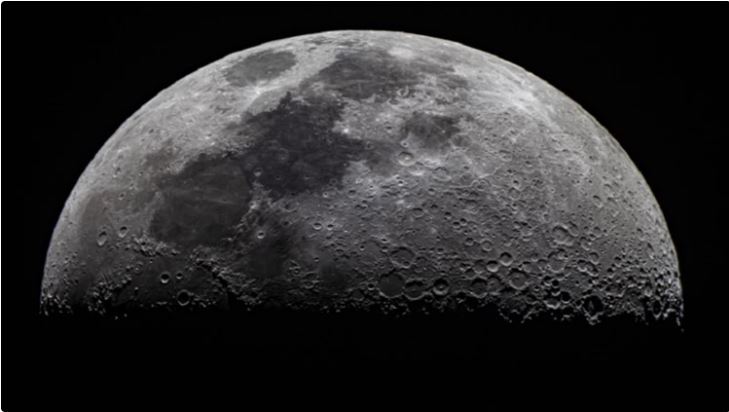
It is widely believed that the Moon formed shortly after Earth itself, about 4.4 billion years or so ago, when the solar system was young.
At that time, according to the theory, a Mars-sized object collided with the still warm and newly formed Earth, sending a huge cloud of debris that had gathered to form the Moon smashing into Earth's orbit.
But a new study of tiny zircon grains in Apollo lunar samples indicates that the Moon is older than we thought, by 40 million years.
This means the moon is at least 4.46 billion years old, says a team led by geologist Jenica Greer, now at the University of Glasgow. Which indicates that it is younger than the age of the Earth, which is estimated at 4.54 billion years.
“These crystals are the oldest known solids that formed after a giant impact,” says Cosmo chemist Philip Heck, of the Field Museum and the University of Chicago. “Because we know the age of these crystals, they serve as an anchor to the lunar chronology.”
It is not known specifically how and when the Moon formed, but the presence of some specific elements strongly indicates a terrestrial origin. The currently favored giant impact hypothesis is at some point in the early solar system, when astronomers expect a much larger number of large objects and protoplanets moving around and colliding with each other.
Estimates have varied about when this giant collision occurred, but a growing body of evidence, based on the dating of moon samples, indicates that it was much older than initial assumptions, with some analyzes revealing that it formed 4.51 billion years ago.
Zircon crystals are an excellent way to trace the age of a specimen because of the peculiar way in which they form. When zircon crystals form, they contain uranium, but they strongly reject lead. Over time, the radioactive uranium in zircon decays into lead at a well-understood rate. Scientists can look at the ratios of uranium to lead in a zircon crystal and find out how long ago the zircon was formed, with a high level of accuracy.
Greer and her colleagues studied zircons found in samples from Apollo 17, the last lunar mission in 1972. The team says that these crystals may have formed after the surface of the moon solidified, from the molten global ocean that covered it immediately after its formation.
The researchers used atomic probe tomography to study the composition of their samples, sharpening the crystals to a point, then using a laser to vaporize atoms from the point. The mass spectrometer analyzed the evaporated material to measure its heaviness, which allowed scientists to determine the ratios of uranium to lead.
This in turn showed that the age of these specific crystals was 4.46 billion years. Which means that the moon's age must be at least that.
The research is scheduled to be published in Geochemical Perspectives Letters.
Reality Of Islam |
|

After spend
A study of

Researchers
 9:3:43
2018-11-05
9:3:43
2018-11-05
10 benefits of Marriage in Islam
7:5:22
2019-04-08
benefits of reciting surat yunus, hud &
9:45:7
2018-12-24
advantages & disadvantages of divorce
11:35:12
2018-06-10
6:0:51
2018-10-16
9:42:16
2022-10-19
6:14:3
2023-01-18
11:11:59
2023-02-01
5:57:34
2023-03-18
7:34:7
2023-02-28
2:11:12
2022-10-15
3:42:22
2021-12-24
5:41:46
2023-03-18
| LATEST |
 HOME
HOME